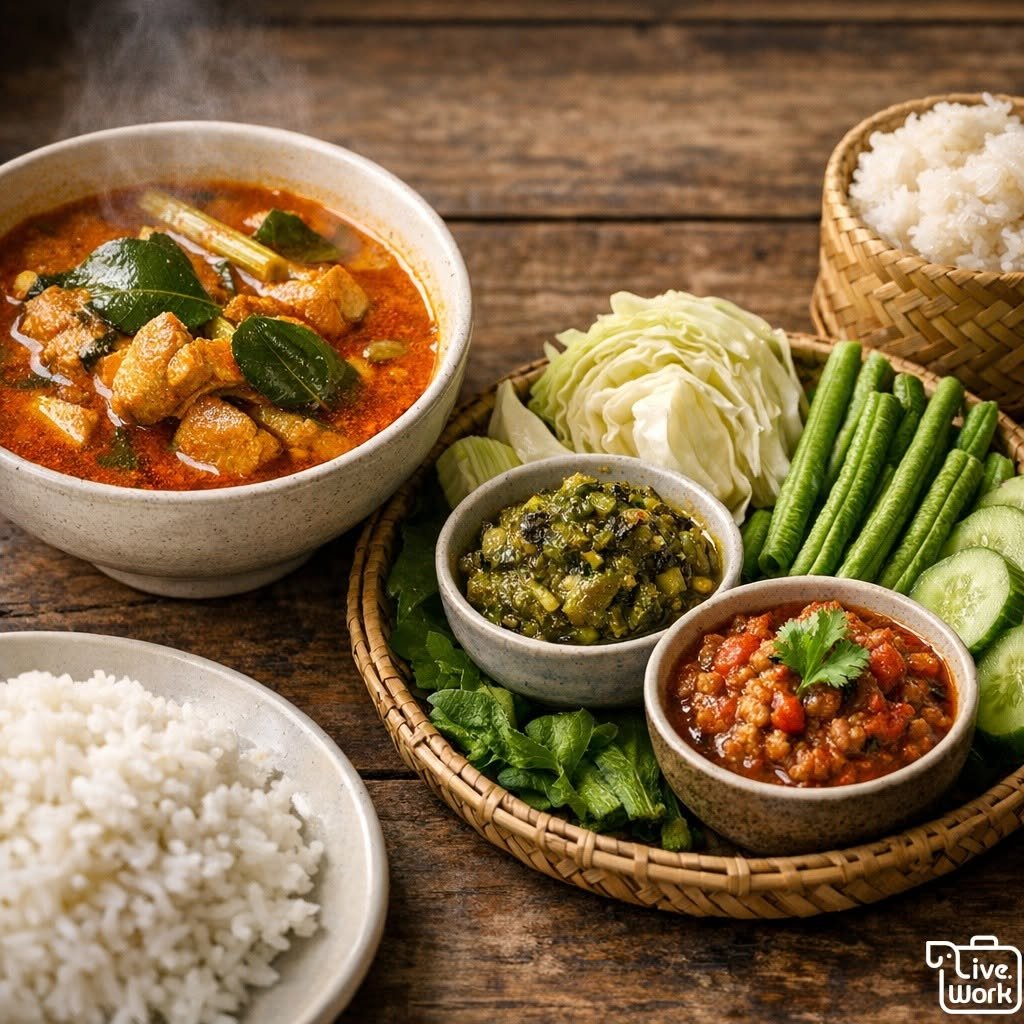
Southern Thai Curries vs Northern Thai Chili Dips: Two Very Different Kinds of Spice
Southern Thai curries and Northern Thai chili dips may both be described as spicy, but they deliver heat in completely different ways. Southern dishes such as gaeng tai pla and Southern-style gaeng som often combine fresh chilies, sourness, turmeric, aromatic herbs, and fermented seafood into powerful curries designed to be eaten with plenty of rice. Northern dips such as nam prik noom and nam prik ong rely more on roasted ingredients, smoke, tomatoes, herbs, and a slower build of flavor.
The difference is not simply that Southern Thai food is hotter. Texture, cooking method, acidity, aroma, and the way the dish is eaten all change the experience. A Southern curry spreads through rice and becomes part of a larger shared meal, while a Northern dip is usually eaten one bite at a time with sticky rice, vegetables, pork cracklings, or grilled meat.
Travelers who enjoy bright sourness, concentrated seafood flavors, and intense chili heat are likely to appreciate Southern Thai curries. Those who prefer smoky aromatics, earthy flavors, fresh vegetables, and a more interactive meal may find Northern Thai chili dips easier to approach.
Why “Spicy” Means Different Things Across Thailand
Thai food does not use chili in one uniform way. Regional cuisines developed around different climates, agricultural products, trade routes, communities, and preservation methods. The result is that heat can arrive through a thin sour broth, a thick coconut curry, a dry spice paste, a grilled chili dip, or a fermented condiment.
Southern Thailand has a warm coastal climate and a strong connection to seafood. Turmeric, black pepper, chilies, lemongrass, makrut lime leaves, shrimp paste, and fermented fish products appear frequently. Southern curries are often assertive enough to stand beside rich fish, fatty meat, coconut milk, and large portions of rice.
Northern Thai cuisine developed in a mountainous region with different culinary influences and a strong tradition of eating sticky rice. Roasting ingredients over heat is common, creating smoky flavors in chilies, garlic, shallots, tomatoes, and other aromatics. Many Northern meals are built around dips, vegetables, grilled foods, soups, and small shared dishes.
Both cuisines can be intensely spicy. The important distinction is how that heat is carried and what surrounds it.
Comparing Southern Curries and Northern Chili Dips
Southern curries are normally served as complete cooked dishes containing broth or sauce, herbs, vegetables, fish, seafood, or meat. Northern chili dips, known collectively as nam prik, are concentrated condiments served with separate accompaniments.
| Characteristic | Southern Thai Curries | Northern Thai Chili Dips |
|---|---|---|
| Typical flavor profile | Fiery, sour, aromatic, salty, and sometimes deeply fermented or enriched with coconut milk. | Smoky, savory, earthy, herbaceous, and often balanced by fresh vegetables and sticky rice. |
| Common ingredients | Fresh chilies, turmeric, lemongrass, makrut lime, shrimp paste, fermented fish products, seafood, and sour fruit. | Roasted chilies, garlic, shallots, tomatoes, herbs, pork, fermented seasonings, and grilled aromatics. |
| Texture | Usually saucy or broth-based, although some Southern curry dishes are thick or nearly dry. | Usually mashed, pounded, chunky, or paste-like and served in a small bowl. |
| How it is eaten | Spooned over or eaten alongside jasmine rice as part of a shared meal. | Scooped with sticky rice or eaten with vegetables, pork cracklings, sausage, and grilled meat. |
| Best suited to | Diners who enjoy intense chili heat, sourness, seafood flavors, and strongly seasoned rice dishes. | Diners who enjoy roasted aromas, contrasting textures, and assembling each bite themselves. |
The table provides a useful general comparison, but individual dishes vary. Not every Southern curry contains coconut milk, and not every Northern dip is mild. In fact, several traditional versions can be much hotter than their smoky aroma initially suggests.
Gaeng Tai Pla: Fermented Depth and Powerful Heat
Gaeng tai pla, written แกงไตปลา, is one of Southern Thailand’s most intense curries. The name refers to tai pla, a strongly flavored fermented fish-based seasoning traditionally made from preserved fish innards. Its aroma and salty depth are central to the dish.
A typical gaeng tai pla may contain fish, bamboo shoots, long beans, pumpkin, eggplant, or other vegetables, although recipes vary by household and province. The curry paste commonly includes dried or fresh chilies, turmeric, lemongrass, garlic, shallots, pepper, and other aromatics.
Gaeng tai pla is usually dark, concentrated, and strongly seasoned. The fermented component creates an umami-rich flavor that can seem unfamiliar to diners accustomed to sweeter central Thai curries. Chili heat is not a decorative addition; it is one of the dish’s defining features.
The curry is normally eaten with rice, which softens its saltiness and heat. Fresh vegetables may also be served alongside it, providing crunch and relief between spoonfuls. Trying to eat gaeng tai pla by itself can make the flavor seem harsher than intended because the dish is designed as one part of a balanced shared meal.
For first-time visitors, a small portion is sensible. The fermented aroma and substantial heat make gaeng tai pla challenging, but diners who enjoy anchovies, fish sauce, shrimp paste, or other deeply savory foods may appreciate its complexity.
Southern Gaeng Som: Sour Curry Without Coconut Milk
Gaeng som, written แกงส้ม, means sour curry. Different regions of Thailand prepare it in different ways, and the Southern version is often particularly spicy, sharply sour, and vividly colored by turmeric.
Unlike many Thai curries familiar to international visitors, Southern gaeng som generally does not depend on coconut milk. Its broth is lighter in body but powerful in flavor, allowing acidity, chili, herbs, and seafood to remain prominent.
Fish, prawns, or other seafood may be cooked with vegetables such as papaya, bamboo shoots, pineapple, lotus stems, or local greens. Sourness can come from tamarind, lime, or regional sour fruits, depending on the recipe.
The flavor arrives quickly. Sourness stimulates the palate first, followed by chili heat and the savory taste of seafood and curry paste. Turmeric adds an earthy aroma and characteristic yellow-orange color without making the curry creamy.
Southern gaeng som is a good choice for diners who enjoy bright, acidic food. It can feel lighter than a coconut curry, but lighter does not mean gentler. The combination of sourness and chili can make the heat seem especially sharp.
Coconut Milk in Southern Thai Curries
Southern Thai cuisine uses coconut milk extensively, but it is incorrect to assume that every Southern curry is coconut-based. Gaeng som and gaeng tai pla are commonly prepared without the creamy sweetness associated with dishes such as green curry.
When coconut milk is used, it provides richness rather than necessarily making the dish mild. A Southern coconut curry may still contain large quantities of chili, turmeric, pepper, shrimp paste, and aromatic herbs.
Coconut fat changes the way spice is experienced. It rounds the edges of sharp chili heat and carries fragrant compounds across the palate, but the warmth may remain longer. Rich coconut curries also pair naturally with seafood, oily fish, chicken, or meat.
This is one reason rice is so important. Jasmine rice absorbs the sauce, distributes concentrated seasoning, and prevents every mouthful from becoming dominated by fat or chili.
Khua Kling: Southern Curry Without the Sauce
Not all Southern curry dishes are spoonable. Khua kling, written คั่วกลิ้ง, is a dry Southern curry commonly made by stir-frying minced meat with a concentrated curry paste.
The dish may contain pork, beef, or chicken combined with chilies, turmeric, lemongrass, garlic, pepper, makrut lime leaves, and other seasonings. The mixture is cooked until relatively dry, allowing the paste to cling directly to the meat.
Khua kling demonstrates how Southern Thai spice can become even more concentrated when there is little broth or coconut milk to dilute it. The aroma is intensely herbal, while the heat can build rapidly.
It is best eaten in small amounts with rice and fresh vegetables. Cucumber, long beans, cabbage, and local leaves provide cooling moisture and textural contrast.
Travelers who want Southern flavors but prefer meat to fermented fish may find khua kling more approachable than gaeng tai pla. The spice level can still be formidable, so asking before ordering is advisable.
What Is Nam Prik in Northern Thai Cuisine?
Nam prik, written น้ำพริก, is a broad term for Thai chili dips or relishes. There is no single nam prik recipe. Variations may contain fresh, dried, roasted, or fried chilies combined with garlic, shallots, shrimp paste, fermented soybeans, fish, meat, tomatoes, herbs, lime, or other regional ingredients.
In Northern Thailand, nam prik is often placed at the center of a shared meal with boiled or raw vegetables, sticky rice, pork cracklings, sausage, grilled meat, or steamed greens. Diners create individual bites rather than pouring the dip over an entire plate.
This format changes the perception of spice. A concentrated dip may be hot, but each mouthful can be controlled by adjusting the amount of nam prik and increasing the quantity of rice or vegetables.
The vegetables are not merely decoration. Their freshness, bitterness, sweetness, and crunch are important parts of the meal. A mild cucumber produces a different bite from cabbage, long beans, pumpkin, eggplant, or a slightly bitter local leaf.
Nam Prik Noom: Smoky Green Chili Dip
Nam prik noom, written น้ำพริกหนุ่ม, is one of Northern Thailand’s best-known chili dips. The name refers to young green chilies, which are roasted and combined with ingredients such as garlic, shallots, salt, and seasoning.
Roasting gives nam prik noom its defining character. The chilies, garlic, and shallots soften, blacken slightly, and develop smoky sweetness before being peeled and pounded together.
The finished dip is usually green, soft, and slightly fibrous rather than perfectly smooth. Its heat varies significantly. Some versions are mild enough for cautious diners, while others deliver a strong chili burn beneath the roasted aroma.
Nam prik noom is commonly served with steamed vegetables, raw vegetables, sticky rice, and pork cracklings known as khaep mu. The pork cracklings provide salt, fat, and crunch, while vegetables make the dish feel fresher and more balanced.
The dip is especially suitable for people who enjoy grilled peppers, smoky salsa, or roasted vegetable spreads. Its flavor is more immediately familiar than fermented Southern curries, although the chili level should not be underestimated.
Nam Prik Ong: Tomato, Chili, and Pork
Nam prik ong, written น้ำพริกอ่อง, is a Northern Thai dip made with minced pork, tomatoes, chilies, garlic, shallots, and seasonings. Its red-orange appearance and tomato base can make it look similar to a thick meat sauce, but its flavor and role in the meal are distinctly Northern Thai.
Tomatoes add sweetness, moisture, and acidity, while pork contributes richness. Chilies and aromatics provide heat and depth. The texture is generally chunky enough to scoop with vegetables or sticky rice.
Nam prik ong is often considered one of the more approachable Northern dips because the tomato and pork soften the impact of the chili. However, spice levels vary, and some versions contain enough chili to surprise inexperienced diners.
It is commonly eaten with cucumber, cabbage, long beans, steamed vegetables, pork cracklings, and sticky rice. Each accompaniment changes the balance. A crisp vegetable produces a lighter bite, while sticky rice and pork cracklings make the combination richer.
Travelers who are uncertain about nam prik noom’s green chili intensity may find nam prik ong a comfortable introduction to the Northern dip tradition.
Sticky Rice Changes the Northern Thai Experience
Northern Thai meals commonly use glutinous rice, known as khao niao and written ข้าวเหนียว. Despite the English name, glutinous rice does not naturally contain gluten; the term describes its sticky texture.
Diners usually take a small portion with the fingers, shape it lightly, and use it to pick up or scoop a dip. The rice has a firm, chewy texture that works well with concentrated condiments.
Sticky rice provides more control than pouring a curry over jasmine rice. The diner decides how much dip to include in each bite and can alternate between chili dip, vegetables, meat, and other shared dishes.
Hands should be clean, and only the portion being eaten should be touched. Sticky rice is commonly served in a shared woven container, so diners take a small amount and place it on their own plate before eating.
Which Cuisine Is Usually Spicier?
Southern Thai cuisine has a reputation for being among Thailand’s hottest regional cuisines, and many Southern curries support that reputation. Fresh chilies, dried chilies, black pepper, turmeric, and concentrated curry pastes can create immediate and persistent heat.
Northern Thai food is often described as milder, but this description is too broad. Nam prik noom can be extremely hot, and several Northern soups, sausages, curries, and dips contain substantial chili.
The difference is often one of concentration and delivery. Southern curry spreads through the entire serving of rice and may combine heat with sourness, salt, fermented seafood, and hot liquid. A Northern dip is concentrated in the bowl but can be applied in smaller amounts.
Diners who have low spice tolerance may therefore find a Northern dip easier to manage, even when the dip itself is hot. The ability to control each bite creates a practical advantage.
How to Order According to Your Spice Tolerance
The Thai phrase เผ็ดน้อย, pronounced approximately “phet noi,” means less spicy or only a little spicy. ไม่เผ็ด, pronounced “mai phet,” means not spicy.
These requests are useful, but they do not work equally well for every dish. A curry that has already been prepared in a large pot cannot easily be made milder for one customer. Traditional curry pastes may also contain chili as a structural ingredient rather than an optional seasoning.
At a made-to-order restaurant, the cook may be able to reduce fresh chilies. At a rice-and-curry stall, the more practical solution is to choose a naturally gentler dish and take only a small portion of the spicy curry.
Nam prik is usually prepared in advance, but diners can control the heat by using less dip and more vegetables or sticky rice.
When asking whether something is spicy, the answer may reflect local standards. A dish described as “a little spicy” by a Southern Thai cook may still feel very hot to an unfamiliar visitor.
Balancing a Southern Thai Meal
Southern curries are rarely intended to be eaten alone. A balanced meal may combine a fiery curry with rice, fried fish, an omelet, fresh vegetables, a mild soup, or another less aggressive dish.
An omelet is particularly useful because egg and oil soften chili heat. Fresh cucumber, long beans, cabbage, and local leaves provide water and crunch.
Sweet drinks may provide temporary relief, but a large sugary beverage can overwhelm the meal. Rice, vegetables, and milder shared dishes generally produce a more balanced experience.
Taking several different dishes is often better than ordering one enormous portion of curry. Thai meals are structured around contrast, and the strongest curry becomes more enjoyable when it does not dominate every mouthful.
Building a Northern Thai Dip Platter
A Northern dip meal is naturally modular. Nam prik noom or nam prik ong forms the center, while diners choose sticky rice, vegetables, pork cracklings, sai ua sausage, grilled pork, boiled eggs, or steamed greens around it.
Vegetables should be treated as active flavor components. Cucumber cools the palate, cabbage provides sweetness and crunch, and boiled pumpkin offers softness and natural sweetness.
Pork cracklings are traditional and satisfying but rich. Combining them with vegetables creates a more balanced experience than using them as the only dipping accompaniment.
Ordering both nam prik noom and nam prik ong is a useful way to compare Northern flavors. The first highlights roasted green chilies and smoke, while the second introduces tomato, pork, and a gentler savory richness.
Dietary Restrictions and Hidden Ingredients
Southern Thai curries frequently contain fish, shrimp paste, fermented seafood, fish sauce, or seafood stock. A vegetable curry should not automatically be assumed to be vegetarian.
Gaeng tai pla is unsuitable for vegetarians because fermented fish is fundamental to the dish. Southern gaeng som often contains seafood and may use shrimp paste in the curry paste.
Nam prik recipes can also contain hidden animal products. Shrimp paste, fish sauce, fermented fish, pork, or other meat ingredients may be included even when the dip is served mainly with vegetables.
Nam prik ong normally contains minced pork. Nam prik noom may appear plant-based but can be seasoned differently by each cook.
People with seafood allergies should ask specifically about shrimp paste, fish sauce, and fermented fish products. Shared mortars, utensils, grills, and preparation surfaces are common, so severe allergies require additional caution.
Common Misunderstandings
One common misunderstanding is that all Southern Thai curries contain coconut milk. Some of the region’s most recognizable dishes, including Southern gaeng som and gaeng tai pla, are not creamy coconut curries.
Another is that Northern Thai food is mild. Roasting creates sweetness and smoke, but it does not remove the heat from green chilies.
Visitors may also treat nam prik as a sauce to pour over everything. Northern dips are usually eaten more selectively, allowing each diner to build individual bites.
Fermented aromas are sometimes interpreted as signs that food is spoiled. In dishes such as gaeng tai pla, fermentation is deliberate and provides essential savory depth. The aroma may be challenging, but it is part of the intended flavor.
Finally, asking which region has “better” spicy food misses the point. Southern curries and Northern dips serve different roles and are designed around different accompaniments.
Choosing Between Southern Curries and Northern Dips
Choose Southern Thai curries when you want bold food that immediately commands attention. Gaeng som offers sharp sourness and chili heat, gaeng tai pla adds concentrated fermented seafood flavor, and coconut-based curries combine richness with powerful aromatics.
Choose Northern Thai dips when you enjoy controlling each bite. Nam prik noom provides roasted green chili and smoke, while nam prik ong combines tomato, pork, and savory warmth. Sticky rice, vegetables, grilled foods, and cracklings make the meal interactive and varied.
Travelers new to regional Thai food may find nam prik ong the easiest starting point. Nam prik noom is a good next step for those comfortable with green chilies. Southern gaeng som suits diners who love sour food, while gaeng tai pla is better reserved for adventurous eaters who already enjoy fermented seafood flavors.
Conclusion
Southern Thai curries and Northern Thai chili dips demonstrate that Thai spice is not a single flavor or level of heat. Southern curries often combine intense chilies with turmeric, sour fruit, seafood, herbs, and fermentation, producing sauces and broths designed to spread through jasmine rice.
Northern dips concentrate roasted chilies, garlic, shallots, tomatoes, herbs, and meat into smaller portions eaten with sticky rice, vegetables, and grilled foods. Their smoky aromas and interactive serving style make the experience feel completely different, even when the chili level is high.
Choose the South for bright sourness, fermented depth, and a fiery curry that shapes the entire meal. Choose the North for roasted aromas, earthy flavors, fresh accompaniments, and the freedom to build each bite according to your own spice tolerance.
The most rewarding approach is to try both in their proper context. A Southern curry needs rice and balancing side dishes, while a Northern nam prik needs sticky rice, vegetables, and contrasting textures. Understanding how each dish is intended to be eaten reveals far more than simply asking which one is hotter.