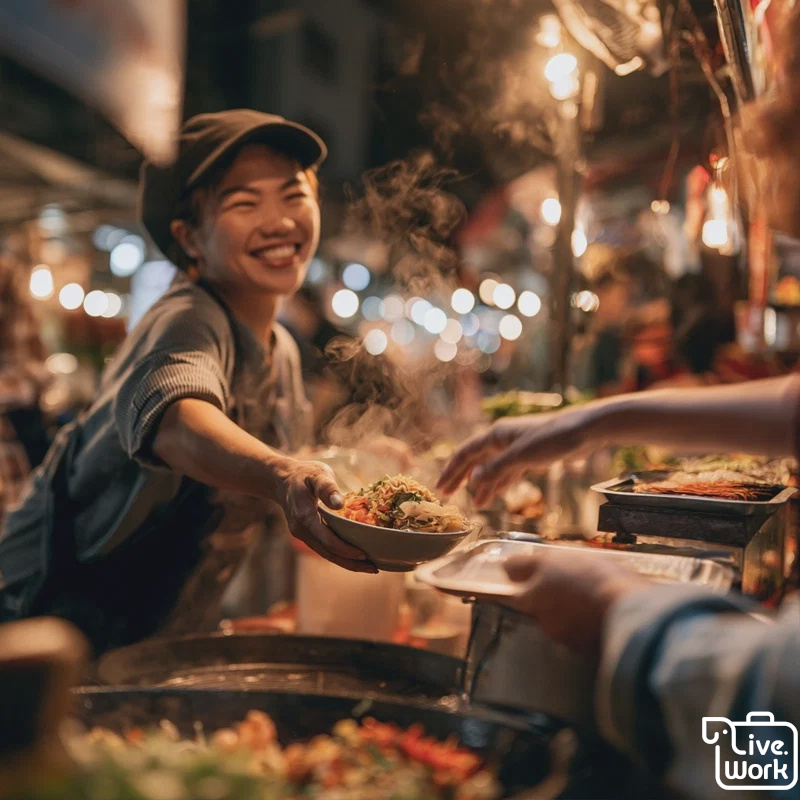
How to Order Thai Street Food Without Knowing the Dish Names
Ordering Thai street food does not require memorizing dozens of dish names or speaking fluent Thai. At markets, roadside stalls, food courts, and neighborhood vendors across Thailand, pointing at the food you want and using a few polite phrases is often enough to order confidently.
A simple เอาอันนี้ครับ or เอาอันนี้ค่ะ, pronounced approximately “ao an-nee khrap/kha,” means “I’ll take this one.” From there, you can ask whether the dish is spicy, request less chili, confirm the price, or ask what an unfamiliar ingredient is.
Street-food ordering in Thailand is generally practical and informal. Vendors are accustomed to customers looking at trays, ingredients, grills, pots, and prepared dishes before deciding. A smile, patient communication, and clear pointing usually matter more than perfect pronunciation.
Knowing a handful of Thai expressions makes the experience easier, particularly away from major tourist areas where English menus may be limited or nonexistent.
The Easiest Thai Phrase: “I’ll Take This One”
The most useful phrase for ordering directly from a stall is เอาอันนี้, pronounced approximately “ao an-nee.”
เอา, or ao, means to take or want in this context. อันนี้, or an-nee, means “this one.” Together, the phrase communicates that you would like the item you are pointing at.
A male speaker can say เอาอันนี้ครับ, “ao an-nee khrap,” while a female speaker can say เอาอันนี้ค่ะ, “ao an-nee kha.”
The polite particles ครับ, khrap, and ค่ะ, kha, make the request sound friendlier and more courteous. Visitors do not need to attach them perfectly to every sentence, but using them naturally is appreciated.
Point clearly at the dish, tray, skewer, fruit, or ingredient while saying the phrase. Vendors may then ask how many portions you want, whether you want rice, whether the food should be eaten there or taken away, or whether you want any additional ingredients.
If communication becomes difficult, there is nothing wrong with using fingers to indicate quantity or showing a number on a phone.
Useful Thai Street-Food Phrases at a Glance
A few phrases cover most simple ordering situations.
| Thai Phrase | Easy Pronunciation | Meaning | When to Use It |
|---|---|---|---|
| เอาอันนี้ครับ/ค่ะ | ao an-nee khrap/kha | I’ll take this one. | Use while pointing at the dish or item you want. |
| อันนี้คืออะไรครับ/คะ? | an-nee kheu a-rai khrap/kha? | What is this? | Use when you want to know what a dish or ingredient is. |
| เผ็ดไหมครับ/คะ? | phet mai khrap/kha? | Is it spicy? | Ask before ordering when the spice level is unclear. |
| เผ็ดน้อยครับ/ค่ะ | phet noi khrap/kha | Less spicy, please. | Use for dishes that can be adjusted while being cooked. |
| ไม่เผ็ดครับ/ค่ะ | mai phet khrap/kha | Not spicy, please. | Use when you want as little chili heat as possible. |
| เท่าไหร่ครับ/คะ? | thao-rai khrap/kha? | How much? | Use to confirm the price before ordering or paying. |
| ขอบคุณครับ/ค่ะ | khop khun khrap/kha | Thank you. | Use after ordering, receiving food, or paying. |
Perfect tones are not essential for a first attempt. Pointing, context, body language, and polite interaction usually make the intended meaning clear.
How to Ask What a Street-Food Dish Is
Thai markets often display dishes without English labels. Instead of ignoring something interesting because you do not recognize it, ask อันนี้คืออะไรครับ/คะ?, pronounced approximately “an-nee kheu a-rai khrap/kha?”
The phrase means “What is this?”
The vendor may answer with the Thai name of the dish, which may not immediately help if you do not speak Thai. However, they may also point to the main ingredient, say “chicken,” “pork,” “fish,” or “vegetable” in English, or show you what is inside.
At curry-and-rice stalls, pointing can be particularly effective because the dishes are already visible. You can inspect several trays, ask about unfamiliar curries, and choose one or two toppings to eat with rice.
At grilled-food stalls, the ingredients may be even easier to identify visually. Chicken, pork skewers, sausages, fish, squid, mushrooms, and vegetables are often displayed before cooking.
If you have dietary restrictions or allergies, identifying only the visible ingredient is not enough. Sauces, curry pastes, broths, and marinades may contain fish sauce, shrimp paste, oyster sauce, peanuts, soy, egg, or other ingredients that are not obvious.
How to Ask Whether Thai Food Is Spicy
The phrase เผ็ดไหมครับ/คะ?, pronounced approximately “phet mai khrap/kha?”, means “Is it spicy?”
เผ็ด, phet, means spicy or hot from chili. ไหม, mai, turns the statement into a yes-or-no question.
The answer is relative. A Thai vendor who says a dish is “a little spicy” may still be describing a level that feels extremely hot to someone with low chili tolerance.
If you are sensitive to spice, asking whether a dish contains chili at all may be more useful than relying entirely on how the vendor rates its heat.
Some foods are naturally mild, while others are built around chili. A bowl of chicken rice can often be eaten with the spicy sauce on the side, whereas a Southern curry or prepared chili dip may already contain substantial chili throughout the dish.
Asking for Less Spice: Phet Noi
เผ็ดน้อย, pronounced “phet noi,” means less spicy or only a little spicy.
This phrase works particularly well with food that is cooked to order, such as stir-fries, some noodle dishes, fried rice, or freshly prepared salads. The cook can reduce the amount of fresh chili added during preparation.
A visitor ordering pad kra pao, for example, might say กะเพราเผ็ดน้อยครับ/ค่ะ, meaning basil stir-fry with less spice.
However, phet noi does not guarantee a mild dish by international standards. A cook may simply reduce six chilies to three rather than eliminating them completely.
If your tolerance is very low, show that clearly through your wording and body language. Saying “phet noi, noi mak,” or emphasizing that you want very little chili, can help.
What “Mai Phet” Really Means
ไม่เผ็ด, pronounced “mai phet,” means “not spicy.”
This is useful when ordering made-to-order food, but it cannot always remove every source of chili. Some sauces, curry pastes, marinades, soups, and prepared dishes contain chili before you arrive.
A vendor selling a large pot of curry cannot make one serving non-spicy without preparing a completely different dish. Similarly, som tam or certain sauces may have ingredients whose flavor depends heavily on chili.
If the food is already prepared and you are uncertain about the heat, ask before ordering and choose another dish if necessary.
For very spice-sensitive visitors, simple foods such as grilled chicken, plain rice, omelets, chicken rice, some noodle soups, and dishes with sauce served separately may be easier starting points.
Confirm the Price Before Ordering
The basic Thai question for “How much?” is เท่าไหร่ครับ/คะ?, pronounced approximately “thao-rai khrap/kha?”
When pointing at a specific item, you can say อันนี้เท่าไหร่ครับ/คะ?, or “an-nee thao-rai khrap/kha?”, meaning “How much is this one?”
Many stalls clearly display prices, especially at food courts, markets, and popular street-food areas. At others, the price may depend on the quantity, meat selection, portion size, or number of toppings.
Asking is completely normal and does not imply distrust. It simply confirms what you are ordering.
If the spoken Thai number is difficult to understand, vendors often use a calculator, hold up fingers, or type the amount into a phone. You can do the same.
Keeping small Thai banknotes is useful at markets and simple roadside stalls. Digital payments are common among Thai customers, but international visitors should not assume that every vendor can accept their preferred payment method.
Ordering from a Thai Rice-and-Curry Stall
Rice-and-curry stalls are among the easiest places to order without knowing Thai dish names.
Known as ร้านข้าวแกง, or raan khao gaeng, these stalls display prepared curries, stir-fries, vegetables, eggs, meat dishes, and other foods in metal trays or bowls.
Customers usually choose one or more dishes to be served with rice. Instead of memorizing each name, simply point.
You can say เอาอันนี้, “ao an-nee,” for the first dish and แล้วก็อันนี้, approximately “laeo gor an-nee,” meaning “and this one too,” for another.
If the dishes look spicy, ask phet mai before choosing. Curries at these stalls are generally prepared in advance, so the vendor cannot significantly change their spice level.
The advantage is that you can see exactly what is available and create a plate based on color, ingredients, and curiosity rather than a written menu.
Ordering Made-to-Order Thai Street Food
Made-to-order stalls are known as ahaan tam sang, written อาหารตามสั่ง. The term essentially means food cooked according to the order.
These stalls commonly prepare dishes such as pad kra pao, fried rice, stir-fried vegetables, garlic pork, omelets, and other fast wok dishes.
Because the dish is cooked after you order, customization is easier. You can request less chili, no chili, a fried egg, a particular meat, or sometimes extra vegetables.
Photos or displayed ingredients can help when the menu is entirely in Thai. If another customer receives something appealing, you can politely indicate that you would like the same dish.
Avoid reaching across the counter or touching raw ingredients. Pointing from your side of the stall is sufficient.
Eating There or Taking It Away
Vendors may ask whether you want to eat at the stall or take the food away.
The Thai expression กินที่นี่, pronounced approximately “gin tee-nee,” means “eat here.”
กลับบ้าน, “glap baan,” literally means “go home” and is commonly understood in food-ordering contexts as takeaway. You may also hear ใส่ถุง, “sai thung,” meaning to put it in a bag.
You do not need to memorize these phrases to manage the conversation. When a vendor holds up a takeaway container and points toward the seating area, the meaning is usually clear.
If environmental waste matters to you, eating at the stall can reduce disposable packaging when reusable plates and cutlery are available.
How to Order a Fried Egg
A fried egg is one of the most useful additions to Thai street food, particularly with spicy dishes.
The Thai term is ไข่ดาว, pronounced approximately “khai dao.” It literally translates roughly as “star egg.”
If you are ordering pad kra pao and want a fried egg, simply add ไข่ดาวครับ/ค่ะ, “khai dao khrap/kha.”
There may be an additional charge, so confirm the final price if necessary.
The yolk may be cooked differently from what you expect. Thai-style fried eggs can have crisp edges and a soft yolk, although every stall has its own method.
Egg can also help balance a spicy dish by adding richness and a milder flavor between bites.
Pointing Is Completely Normal
Visitors sometimes worry that pointing at food seems rude. In a market context, clear pointing at a dish or menu item is practical and widely understood.
The key is how you point. Indicating the food with a relaxed hand while speaking politely is very different from pointing aggressively at a person.
Do not reach over trays, touch ingredients, or pick up food unless the vendor invites you to do so.
At fruit stalls or grilled-skewer stalls, some vendors may provide a basket or tongs for customers to select items themselves. Watch what other customers do before assuming.
When language fails completely, smiling, pointing, holding up the required quantity with your fingers, and saying khop khun can complete the transaction successfully.
Street-Food Etiquette That Makes Ordering Easier
Thai street-food stalls can become extremely busy during breakfast, lunch, and evening meal periods. Knowing what you want before reaching the front helps the vendor and the people waiting behind you.
Stand where you can see the food without blocking customers who are collecting orders. When several people are waiting, observe whether there is an informal queue.
Have money ready when the food is handed over, particularly at small stalls where the vendor is simultaneously cooking, serving, and handling payments.
Aggressive bargaining over prepared food is generally unnecessary. A bowl of noodles or plate of rice is normally sold at a standard price. Asking the cost is fine; trying to negotiate a small reduction from an everyday food vendor usually is not.
A simple thank-you at the end completes the interaction naturally.
What to Do When There Is No English Menu
A missing English menu can actually make ordering easier because it encourages you to look at what people around you are eating.
Prepared-food stalls allow direct pointing. At noodle stands, you may see ingredients displayed behind glass. Grill stalls place skewers and meat in front of customers. Dessert vendors may have finished examples on trays.
Photographs on a phone can help when searching for a particular dish, but avoid expecting every stall to reproduce an unrelated restaurant’s version exactly.
Translation apps can be useful for dietary restrictions or complicated questions, but they are rarely necessary for a simple order.
The most efficient process is often to ask “an-nee kheu a-rai?”, listen to whatever explanation is possible, decide whether it looks appealing, and then say “ao an-nee.”
How to Handle Food Allergies and Dietary Restrictions
Pointing alone is not sufficient when an ingredient could cause a serious allergic reaction.
Thai cooking frequently uses fish sauce, oyster sauce, shrimp paste, peanuts, soy sauce, egg, coconut milk, and shared cooking oil. A dish that looks vegetarian may contain animal-based seasoning, while a food without visible peanuts may have been prepared beside peanut-containing dishes.
Cross-contact is common at small stalls because the same wok, knife, spoon, grill, mortar, or cutting board may be used repeatedly.
People with severe allergies should carry the restriction written clearly in Thai and choose vendors where ingredients can be discussed with confidence.
Vegetarians should also ask beyond visible meat. The phrase มังสวิรัติ, pronounced approximately “mang-sa-wi-rat,” means vegetarian, but interpretations can vary.
Thai jay food, written เจ, follows a stricter plant-based tradition and can be easier to identify at stalls displaying the familiar yellow-and-red jay sign, particularly during the annual Vegetarian Festival.
Choosing a Street-Food Stall
A busy stall can be a useful sign because ingredients and prepared food are moving quickly.
For hot food, look for dishes being cooked fresh or kept properly heated. For grilled items, it is reassuring to see food cooked thoroughly rather than left sitting for long periods in the heat.
Prepared fruit should look fresh and protected from excessive heat and insects. Cold dishes should be stored appropriately.
Clean utensils, organized preparation areas, and regular customer turnover provide useful practical signals.
Street food should be approached with the same judgment used anywhere else. If something looks poorly stored, smells unusual in a way that does not seem intentional, or makes you uncomfortable, choose another stall.
There is rarely any shortage of alternatives.
Common Mistakes First-Time Visitors Make
One mistake is trying to pronounce a complicated Thai dish name perfectly when pointing would communicate the order more clearly.
Another is saying mai phet and assuming every dish can be made completely chili-free. Prepared curry, chili paste, and premixed sauces may already contain heat.
Visitors also sometimes forget to ask about portion size or extras. A fried egg, extra meat, larger serving, or multiple curry toppings may increase the price.
Bargaining aggressively over street food is another unnecessary mistake. The goal should be a smooth exchange rather than winning a negotiation over a small amount.
Finally, some travelers avoid local stalls because they are embarrassed about language. This often means missing some of the easiest and most enjoyable food experiences in Thailand.
A Simple First Street-Food Order
Imagine you find a stall displaying several trays of food and one looks particularly appealing.
Point at it and ask อันนี้คืออะไรครับ/คะ?, “an-nee kheu a-rai khrap/kha?”, to find out what it is.
If you are concerned about chili, follow with เผ็ดไหมครับ/คะ?, “phet mai khrap/kha?”
If the answer sounds suitable, ask เท่าไหร่ครับ/คะ?, “thao-rai khrap/kha?”, to confirm the price.
Then point and say เอาอันนี้ครับ/ค่ะ, “ao an-nee khrap/kha.”
When the vendor hands you the food, finish with ขอบคุณครับ/ค่ะ, “khop khun khrap/kha.”
That short exchange is enough to order successfully at countless Thai markets and street stalls.
Conclusion
Ordering Thai street food is much easier than it first appears. You do not need to recognize every curry, noodle dish, skewer, soup, or dessert. A few practical phrases combined with clear pointing can handle most everyday situations.
Start with เอาอันนี้, “ao an-nee,” for “I’ll take this one.” Ask เผ็ดไหม, “phet mai,” if you need to know whether something is spicy, use เผ็ดน้อย, “phet noi,” for less spice, and confirm the cost with เท่าไหร่, “thao-rai.”
Street-food communication is usually based on cooperation rather than perfect language. Watch what local customers do, be patient when the stall is busy, ask rather than assume, and finish with a polite ขอบคุณ, “khop khun.”
Once the fear of ordering disappears, Thai markets become much more interesting. Instead of selecting only dishes with English signs, you can follow aromas, colors, ingredients, and curiosity—and discover food simply by pointing and asking, “What is this?”