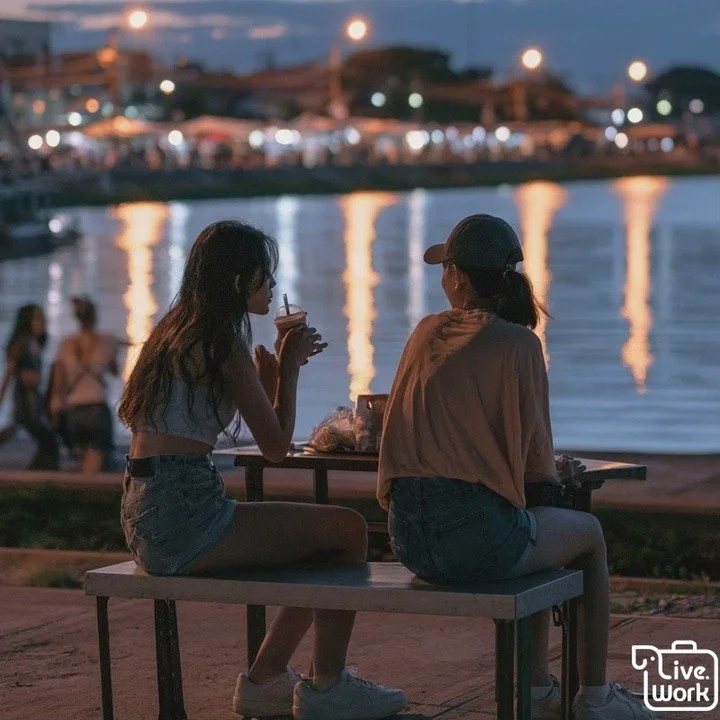
A Slow Evening in Ubon Ratchathani: Cafés, the Mun River, and Isan Night Markets
Ubon Ratchathani is particularly enjoyable when there is no major attraction to rush toward. As late-afternoon heat begins to ease, the city settles into an unhurried evening rhythm of independent cafés, riverside walks, neighborhood conversations, food stalls, and families gathering outdoors.
A simple Ubon evening can begin with coffee in the old city, continue toward the Mun River as the light softens, and finish among grilled meats, sticky rice, spicy salads, fruit, and Thai sweets at a night market. On weekends, the Riverside Walking Street beside the Mun River adds food, crafts, and local performances to the waterfront atmosphere.
This is not an itinerary built around ticking off famous landmarks. It is a way to experience everyday life in one of the major cities of Isan, Thailand’s northeastern region. Ubon Ratchathani sits on the Mun River and serves as an important cultural and administrative center of the lower Northeast, while retaining a noticeably slower atmosphere than Bangkok or Thailand’s major resort destinations.
Why Ubon Ratchathani Works So Well for a Slow Evening
Ubon Ratchathani, commonly shortened simply to Ubon, does not demand constant sightseeing. Its appeal comes from combining established neighborhoods, temples, local food, café culture, riverside spaces, and everyday urban life at a comfortable pace.
The city is particularly well known nationally for its annual Candle Festival connected with Buddhist Lent, but visiting outside major festival periods reveals a different Ubon. Streets are calmer, public spaces belong largely to residents, and an evening can unfold without needing reservations, complicated transport, or a long list of attractions.
This makes Ubon especially appealing to travelers who have already experienced Thailand’s busiest destinations. Instead of another evening organized around nightlife or a major tourist attraction, the pleasure comes from noticing how people actually use the city after work.
A café becomes the first stop rather than somewhere to rush through. The river becomes a place for an evening walk rather than a photograph. Dinner comes from several small market stalls instead of one formal restaurant.
Start with Ubon Ratchathani’s Independent Café Scene
Beginning the evening with coffee provides an easy transition from the hotter daytime hours. Ubon has developed a creative independent café scene that mixes modern coffee culture with older buildings, residential streets, and a distinctly local pace.
One example is Songsarn Coffee & Home Roaster, an independent coffee space in Ubon’s old town that combines roasting and café culture within a restored older building. Its development reflects a broader local interest in using cafés as creative community spaces rather than simply places to buy a drink.
There is no need to build the entire evening around one famous café. Part of the enjoyment is choosing a small shop near the old city or along the route toward the river and spending enough time there to notice the surroundings.
Thai-grown coffee is increasingly common in independent cafés, particularly beans from northern Thailand. Depending on the shop, menus may include espresso drinks, pour-over coffee, Thai-style iced coffee, tea, fruit drinks, and simple desserts.
If you prefer less sweetness in an iced drink, the Thai phrase หวานน้อย, pronounced approximately “waan noi,” means “less sweet.” For an unsweetened drink, ไม่หวาน, or “mai waan,” means “not sweet.”
An hour is unnecessary unless you genuinely want one. Thirty to forty-five minutes over coffee is enough to slow the pace before moving toward the river.
Let the Mun River Set the Pace
The Mun River, แม่น้ำมูล or Mae Nam Mun, is one of the defining geographical features of Ubon Ratchathani. By late afternoon, the riverfront becomes more comfortable as the sun loses intensity and people begin appearing for walks, exercise, food, and social time.
Unlike a purpose-built resort promenade, the riverfront feels connected to ordinary city life. Fishing boats, traffic, local homes, bridges, vendors, and public spaces all remain part of the scene.
The best way to experience it is simply to walk without trying to cover a specific distance. Stop where the river opens into a broad view, watch the changing light, and continue when you feel like moving again.
Around sunset, the temperature usually becomes more comfortable, although Ubon remains warm for much of the year. A light breeze from the water can make the riverfront particularly pleasant after a hot afternoon.
The Mun is not merely decorative scenery. It is part of the wider Mekong river system and has long shaped settlement, transport, agriculture, and everyday life across northeastern Thailand.
What You See Along the River Matters More Than a Viewpoint
Ubon does not require an elevated sunset platform to create an enjoyable evening. The interest is often at eye level.
You may see runners beginning an evening circuit, grandparents walking with children, groups of teenagers meeting after school, couples sitting beside the water, vendors arranging food, and friends stopping to talk before dinner.
Watching these routines gives a better sense of Ubon than racing between formal attractions.
The light also changes quickly. Before sunset, buildings and trees become warmer in color. After the sun disappears, the river begins reflecting streetlights and market stalls, and the social character of the waterfront becomes more prominent.
Photographers should focus on atmosphere rather than only the sunset itself. Silhouettes beside the river, food stalls preparing for the night, motorcycles arriving, steam rising from grills, and reflections on the water can communicate the city more effectively than a perfectly empty landscape.
People should still be photographed respectfully. Ask permission when someone is clearly the main subject rather than treating residents as scenery.
Riverside Walking Street on Weekend Evenings
Ubon Ratchathani’s Riverside Walking Street adds another dimension to the Mun River during weekend evenings. Current destination coverage describes the walking street as a late-afternoon and evening gathering place with food, handicrafts, and local performances beside the river.
The atmosphere is social rather than intensely touristic. Rows of stalls create an easy route for wandering, eating, and browsing while the river remains visible nearby.
The market works particularly well at the end of a slow evening because there is no need to commit to one restaurant. You can buy a grilled skewer from one stall, sticky rice from another, fruit farther along the promenade, and a Thai dessert before leaving.
Weekend schedules and individual vendor attendance can change because of weather, public events, holidays, and local arrangements. Travelers visiting specifically for Riverside Walking Street should confirm current operating days rather than assuming every evening will have the same activity.
On nights when the riverside walking street is not operating, Ubon still has other evening food areas and night-market options, including the market environment around Thung Si Mueang in the central city.
What to Eat at an Ubon Night Market
An evening market in Ubon is a good place to explore Isan food without ordering an enormous restaurant meal. The strongest approach is to build dinner from several small dishes and eat them together.
| Food | What to Expect | Why It Works at a Night Market |
|---|---|---|
| Som tam | Green papaya salad pounded with chili, lime, seasonings, and other ingredients that vary by style. | Its sour, spicy freshness balances grilled meat and sticky rice. |
| Sticky rice | Khao niao is the everyday glutinous rice associated strongly with Isan food culture. | It is portable, filling, and designed to accompany grilled meat, salads, and chili dips. |
| Grilled chicken or pork | Charcoal-grilled meat may be seasoned with garlic, pepper, herbs, or savory marinades. | Easy to share and particularly good with sticky rice and som tam. |
| Isan sausage | Sai krok Isan is a fermented sausage with a characteristic sour and savory flavor. | Small portions make it easy to try alongside several other foods. |
| Fresh fruit | Selections change according to season and may include pineapple, watermelon, guava, mango, or other local fruit. | Fresh fruit provides a cooling finish after spicy or grilled food. |
| Thai sweets | Coconut desserts, pancakes, sticky-rice sweets, jellies, and other snacks vary between vendors. | A small portion provides an easy final stop while continuing through the market. |
The ideal combination depends on appetite and spice tolerance. Sticky rice, grilled chicken, and som tam form a particularly recognizable Isan combination, but Ubon’s food scene also reflects influences from neighboring Laos and Vietnam.
Rather than searching only for dishes you already know, look at what local customers are buying. A busy stall preparing one or two specialties repeatedly may be more interesting than a vendor attempting to offer an enormous menu.
Som Tam in Ubon Can Be Different from What You Expect
Som tam, ส้มตำ, is common throughout Thailand, but northeastern versions can taste noticeably different from the sweeter style often encountered in tourist restaurants.
Som tam Thai usually combines green papaya with lime, fish sauce, palm sugar, peanuts, dried shrimp, tomato, and chili. Isan-style variations may use fermented fish seasoning, known as pla ra, creating a deeper, saltier, and more pungent flavor.
If you are unfamiliar with fermented fish, ask before ordering rather than assuming every papaya salad tastes the same.
Spice levels can also be formidable. เผ็ดน้อย, pronounced “phet noi,” means less spicy. If you are very sensitive to chili, specifying the number of chilies can sometimes communicate your preference more clearly than describing the desired heat level.
Som tam is best understood as part of a meal rather than an isolated salad. Sticky rice and grilled meat soften its acidity, chili, and strong seasoning.
Try Sai Krok Isan for an Easy Local Snack
Sai krok Isan, ไส้กรอกอีสาน, is one of the easiest regional foods for first-time visitors to try. These fermented pork sausages usually have a savory, slightly sour flavor created through fermentation.
They are commonly grilled and served with raw cabbage, fresh chili, ginger, or other vegetables. The contrast between hot sausage and crisp vegetables makes them particularly suitable as a market snack.
Fermentation intensity differs between vendors. Some sausages taste only gently tangy, while others have a more pronounced sourness.
If you are exploring the market rather than sitting for a full meal, sharing a portion is practical because it leaves room for additional dishes.
Eat Slowly Instead of Buying Everything at Once
Night markets encourage impulse buying. The first row of stalls may look so appealing that it is tempting to purchase an entire meal immediately.
Walk through at least part of the market first. Notice what is being cooked fresh, where locals are waiting, and which foods appear only at one or two stalls.
Then build the meal gradually.
Start with something savory, continue with a salad or grilled dish, and leave fruit and dessert until later. This allows you to respond to your appetite instead of carrying multiple containers around the market.
Food tastes better when eaten fresh from the grill than after sitting in a bag for thirty minutes.
Carrying small Thai banknotes also makes market purchases easier. Many Thai customers pay electronically, but international visitors should not assume that every QR payment system will work with a foreign bank account.
Ubon’s Evening Atmosphere Is the Attraction
One reason this evening works so well is that nothing needs to happen.
There is no required show, rooftop reservation, sunset cruise, or famous restaurant. If coffee takes longer than expected, stay longer. If the river looks good after rain, keep walking. If the market is busy, choose a quieter food area instead.
That flexibility matches Ubon Ratchathani particularly well.
The city receives domestic visitors and becomes considerably busier around major cultural events, especially the famous Candle Festival. Outside those periods, international tourism is far less dominant than in Chiang Mai, Phuket, or Bangkok.
English may therefore be less widely used at small stalls, but simple communication normally works. Pointing at food and saying เอาอันนี้ครับ/ค่ะ, approximately “ao an-nee khrap/kha,” means “I’ll take this one.”
เท่าไหร่ครับ/คะ, “thao-rai khrap/kha?”, means “How much?”
A smile and a polite ขอบคุณครับ/ค่ะ, “khop khun khrap/kha,” completes most interactions.
How to Get Around Ubon Ratchathani in the Evening
Central Ubon is manageable in sections, but attractions are not all concentrated into one compact pedestrian tourism district. Combining walking with ride-hailing services, taxis, local transport, or a private vehicle is usually the most practical approach.
For this evening plan, choose a café and riverfront area that make geographical sense together rather than crossing the entire city repeatedly.
Once near the Mun River or a night market, walking becomes more rewarding. Moving slowly on foot allows you to notice small food stalls, temples, old commercial buildings, and neighborhood businesses that would disappear during a fast car journey.
Traffic is generally less overwhelming than Bangkok, but roads still require attention. Use pedestrian crossings where available and do not assume vehicles will automatically stop.
A scooter is unnecessary for a simple evening. Travelers who do rent motorcycles in Thailand need an appropriate license, valid insurance, a proper helmet, and sufficient riding experience.
When to Start a Slow Evening in Ubon
A good starting point is late afternoon, when the strongest daytime heat begins to decline. Coffee around 4:00 or 4:30 leaves enough time to reach the river before sunset without feeling hurried.
Exact sunset times vary through the year, so check the day rather than relying on one fixed schedule.
The hour around sunset is particularly comfortable for riverside walking. After dark, shift toward the market and make food the main activity.
During the rainy season, afternoon showers can temporarily change the plan. Waiting in a café until heavy rain passes often works better than abandoning the evening entirely. Wet streets, cooler air, and reflections along the river can make the city especially atmospheric afterward.
During hotter periods, water and lightweight clothing are important even after sunset. Ubon’s evening may feel gentler than the afternoon, but humidity remains high.
Visiting during the Ubon Ratchathani Candle Festival
Ubon’s slow everyday atmosphere changes dramatically around the annual Candle Festival. The city is nationally associated with elaborate wax sculptures and processions connected with Buddhist Lent, and the festival draws significantly more visitors.
This can be an excellent time to visit, but it creates a different experience from the quiet evening described here. Accommodation demand, traffic, public spaces, and event areas may all become much busier.
Travelers interested mainly in relaxed local routines may prefer dates outside the festival period. Those who want major cultural celebrations should plan specifically around the event and book accommodation earlier.
Both versions of Ubon are worthwhile, but they should not be confused.
Respectful Market and Riverside Etiquette
Night markets are informal, but a few simple habits improve the experience. Do not block busy stalls while deciding what to order, and step aside after paying so the next customer can move forward.
Prepared food normally has a fixed price. Asking the cost is appropriate, but aggressive bargaining over a plate of food or small snack generally is not.
Use bins where available and avoid leaving plastic cups, skewers, bags, or food containers along the river. Waterways collect discarded packaging easily, making careful disposal especially important beside the Mun.
When photographing vendors, ask permission if the person rather than the food is the main subject. Some sellers enjoy being photographed; others are simply trying to complete a busy evening shift.
Most importantly, remember that the riverfront and market are community spaces. Visitors are joining an existing evening routine rather than entering an attraction designed entirely for tourists.
Who Will Enjoy an Evening in Ubon Ratchathani?
Ubon is particularly rewarding for travelers who enjoy food, cafés, photography, people-watching, and discovering cities through daily routines.
It suits repeat visitors to Thailand who want to move beyond the standard Bangkok–Chiang Mai–islands route. It also works well for travelers exploring Isan more broadly and combining Ubon with destinations along the Mekong or the remarkable landscapes farther east in the province.
Someone searching for large nightlife districts, beach clubs, or constant entertainment will find other Thai cities more suitable.
The appeal of Ubon is almost the opposite. An evening is successful precisely because it can remain uncomplicated.
Coffee, river, dinner, walk.
That is enough.
Conclusion
A slow evening in Ubon Ratchathani offers an easy introduction to everyday life in northeastern Thailand. Begin with coffee at an independent café, head toward the Mun River as the heat fades, and spend the final part of the evening tasting grilled food, sticky rice, som tam, fruit, and desserts at a local market.
The experience works because the city does not demand a complicated schedule. The river provides the scenery, the market provides dinner, and the people around you provide the sense of place.
Weekend visitors can add the Riverside Walking Street when it is operating, while other night markets and food areas provide alternatives on different evenings. What matters more than selecting one specific venue is allowing enough time to wander without rushing.
Ubon Ratchathani shows another side of urban Thailand: quieter, distinctly Isan, and enjoyable precisely because an ordinary evening can become the main event.