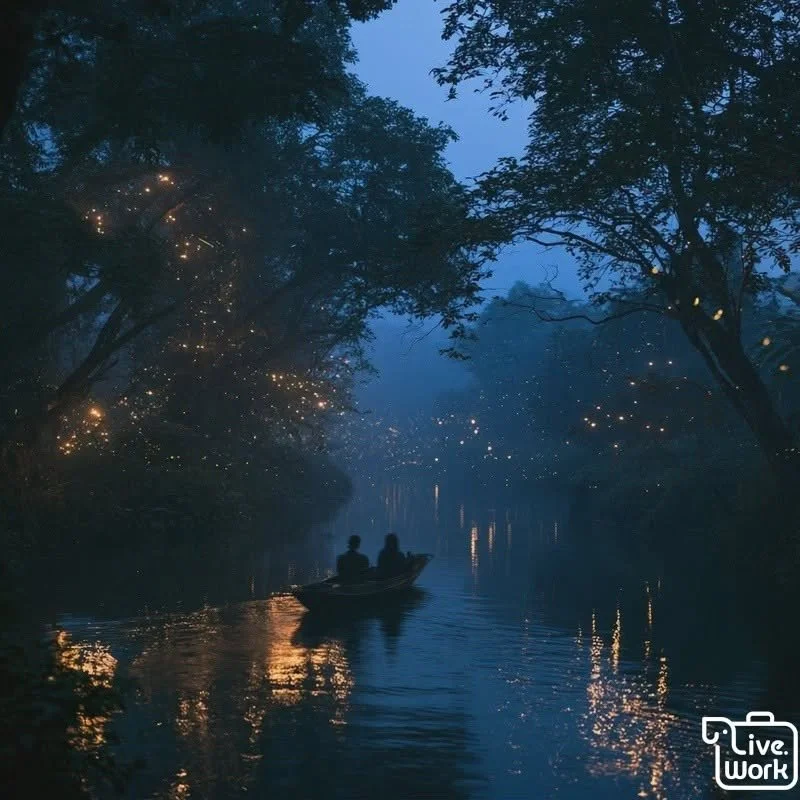
Where to See Fireflies in Thailand: Amphawa, Samut Prakan, and Quiet Riverside Habitats
Watching fireflies in Thailand is a very different experience from visiting a temple, market, or viewpoint. There is no guaranteed performance and no fixed number of lights waiting at a particular tree. The experience depends on healthy habitat, darkness, humidity, weather, water conditions, and the natural behavior of the insects themselves.
One of Thailand’s best-known firefly destinations is Amphawa in Samut Songkhram, where evening boat trips travel along canals and the Mae Klong riverside looking for synchronized fireflies gathering in waterside trees. Around Bangkok, Samut Prakan also supports firefly habitat, particularly in the greener river environment of Bang Krachao. Farther west, forested rivers in Kanchanaburi can provide more incidental firefly encounters, particularly around quiet riverside accommodation away from strong artificial lighting.
The most important part of firefly watching is how you do it. Their flashes are communication signals, so bright lights, camera flashes, noise, handling, and excessive disturbance can interfere with the behavior you came to see. A responsible firefly trip should therefore feel quiet, dark, and slightly unpredictable.
Is There a Firefly Season in Thailand?
Thailand does not have one simple nationwide firefly season. Different species occupy different habitats, and abundance varies according to location, rainfall, temperature, humidity, and local environmental conditions.
In central Thailand, warm and humid months can be particularly productive. Research in Samut Prakan has documented riparian fireflies throughout the year, with higher abundance during roughly July to October at the studied site. Other Thai research has also found strong activity at different times of year, so the rainy season should be treated as a useful general guide rather than a guarantee. Mahidol University
Shortly after sunset is usually the most practical viewing period. Fireflies use their light primarily for communication and courtship, and activity is typically strongest once surrounding daylight has faded.
A warm, still evening after rain can be excellent. Heavy rain, strong wind, flooding, or bright artificial lighting can produce very different conditions.
Amphawa: Thailand’s Classic Firefly Boat Experience
Amphawa in Samut Songkhram is Thailand’s most established firefly tourism destination. The area is defined by canals, coconut-growing communities, the Mae Klong River, and waterside vegetation that provides habitat for synchronized fireflies.
Visitors commonly combine an afternoon at Amphawa Floating Market with an evening boat trip. After dark, boats leave the busier market area and travel toward quieter stretches of water where fireflies gather in riverside trees. The Tourism Authority of Thailand continues to describe nighttime firefly boat trips as one of Amphawa’s characteristic activities. Tourism Authority of Thailand
The fireflies associated with this environment include Pteroptyx malaccae, a species known for congregating in display trees and producing synchronized flashes. These riparian fireflies are closely tied to riverbank vegetation and wet habitats, making preservation of the entire shoreline ecosystem important rather than just the individual trees where adults are visible. Lampyrid Journal
For a quieter version of the experience, communities around Samut Songkhram may offer smaller-scale outings. Tha Kha, for example, has traditionally promoted paddle-powered nighttime firefly trips, reducing engine noise while moving through the canals. Tourism Authority of Thailand
Choose the Quietest Boat You Can
Firefly tourism can damage the habitat when too many boats approach too closely. Amphawa itself has become an important case study in why wildlife tourism needs careful management.
Research has linked intensive tourism there with excessive artificial lighting, engine noise, boat wake, riverbank erosion, disturbance to display trees, and loss of suitable habitat. Camera flashes and boat lights can also interfere with the insects’ flashing behavior. Society for Conservation Biology
When several options are available, choose a small group and a quieter vessel. Paddle boats, low-noise boats, or operators that keep a respectful distance from display trees are preferable to experiences built around getting as close as physically possible.
A responsible guide should not hit, shake, or approach vegetation simply to make fireflies move. More movement does not mean a better wildlife encounter.
Samut Prakan: Look beyond Bang Pu for Fireflies
Bang Pu in Samut Prakan is well known for coastal mangroves, birdlife, and its Gulf of Thailand environment, but it should not be treated as a guaranteed firefly attraction.
For visitors specifically interested in fireflies within Samut Prakan, Bang Krachao is a better-documented option. Researchers have recorded regular synchronized firefly swarms at riverbank locations there, including areas with lamphu trees, also known as mangrove apple trees. Springer Nature Link
Bang Krachao is the large green area enclosed by a bend of the Chao Phraya River south of central Bangkok. Its canals, gardens, wetlands, riverside vegetation, and relatively dark pockets provide a much more suitable setting for searching for fireflies than highly illuminated urban areas.
Unlike Amphawa, however, firefly watching in Bang Krachao is not necessarily organized around a large standardized tourist operation. A local homestay or community-based guide may be more useful than simply arriving after dark and hoping to find a particular tree.
This is also a better style of wildlife viewing. The aim is to find a habitat where fireflies naturally occur, not to create a brightly lit attraction around them.
Kanchanaburi: A More Unpredictable Riverside Encounter
Kanchanaburi offers a different kind of possibility. The province is crossed by major rivers and contains extensive forest, national parks, wetlands, and quieter rural accommodation, particularly toward Sai Yok and other areas along the Khwae Noi River. Tourism Authority of Thailand
Fireflies can occur in suitable riverside and forest habitats, but Kanchanaburi should not be promoted as a guaranteed firefly show in the same way as Amphawa. Sightings may be highly local and seasonal.
The best approach is to choose a quiet riverside or forest stay and ask the accommodation whether fireflies have recently been active nearby. Local staff will usually have a better idea of current conditions than an old travel post or generic map listing.
If fireflies appear, the experience may be more subtle than Amphawa: scattered flashes beside trees, vegetation, or the river rather than a large synchronized display.
That uncertainty is part of the appeal. A genuine wildlife sighting often feels more special when it was not scheduled to the minute.
The Best Time of Night to Watch Fireflies
Begin around dusk and allow your eyes time to adjust.
Do not immediately reach for a phone or flashlight when the surroundings become dark. Human night vision improves gradually, and the weaker flashes become much easier to see after several minutes without bright screens.
Some Thai studies have recorded strong flashing activity during the first few hours of darkness. A practical viewing window is therefore from shortly after sunset into the early evening, rather than waiting until very late at night. Chula Digital Collections
Moonlight, nearby buildings, weather, and vegetation can all affect visibility. A night that produces only a few flashes is not necessarily a failed trip.
Fireflies are wildlife, not decorative lighting.
Why Flash Photography Should Be Avoided
The flash is not simply annoying to other visitors. Light is central to firefly communication.
Research involving Thai Pteroptyx malaccae found that camera illumination changed their flashing behavior. More broadly, artificial light can obscure the visual signals fireflies use to find mates and can reduce successful courtship. IntechOpen
Turn the camera flash off completely.
Phone screens should also be dimmed and used as little as possible. Repeatedly lighting your face and the surrounding vegetation with a bright screen undermines the dark conditions needed for good viewing.
If light is genuinely required for walking safely, use the dimmest possible light, direct it toward the ground, and switch it off once you reach the viewing area. A dim red light generally causes less disruption than bright white or blue-rich light, although even red light should be used only when necessary. Society for Conservation Biology
Photographing Fireflies without Flash
Firefly photography is difficult because the entire scene depends on darkness.
A phone held in automatic mode may produce a black image or brighten the background so aggressively that the fireflies disappear. Activating flash will usually make matters worse while disturbing the insects.
A camera with manual exposure, a stable tripod, a wide aperture, and a longer exposure offers a better chance of recording multiple flashes while retaining the dark atmosphere.
Do not walk into vegetation to improve the composition. Firefly larvae and mating adults can occur close to the ground, and trampling habitat is a recognized threat at heavily visited sites. Society for Conservation Biology
Sometimes the better decision is simply to leave the camera in the bag.
Firefly-Watching Etiquette
The basic rules are simple enough that everyone in a group can follow them.
Stay on the established path, platform, pier, or boat. Do not push through vegetation in pursuit of a brighter cluster.
Never catch a firefly or place one inside a bottle, hand, or container for a photograph. If one lands nearby, allow it to leave on its own.
Keep voices low. Small groups generally create a much better experience than a noisy crowd.
Avoid smoking around the habitat and take all rubbish away with you. In riverside areas, plastic and other waste can easily enter the water.
Most importantly, accept distance. A tree filled with flashing insects is not an invitation to move the boat directly underneath it.
What to Expect from a Responsible Tour
A good firefly experience should make conservation part of the activity rather than an afterthought.
Guides should explain what visitors are seeing, discourage bright lights and flash photography, keep the group under control, and avoid disturbing vegetation.
Small groups are preferable when possible. Quieter boats reduce both environmental disturbance and the noise that otherwise overwhelms the atmosphere.
An operator that promises enormous numbers of fireflies every night should be treated cautiously. Wildlife abundance naturally changes, and no responsible guide can guarantee a specific display.
The strongest tours make the habitat itself interesting. Canals, mangroves, riverside trees, frogs, insects, birds, and nighttime sounds are all part of the experience.
Conclusion
Firefly watching in Thailand is at its best when darkness and patience replace the usual tourist rush. Amphawa remains the most established choice for an evening boat trip, particularly when combined with the canals and floating-market environment of Samut Songkhram. Bang Krachao provides a more ecologically grounded option in Samut Prakan, while quiet riverside areas of Kanchanaburi can produce less predictable but rewarding sightings.
There is no single perfect firefly month across Thailand. Warm, humid conditions and the rainy-season months can be favorable in many central Thai habitats, but abundance varies by species and location.
Wherever you go, the same rules matter: no flash, minimal artificial light, quiet observation, small groups, no handling, and no entering the habitat for a closer photograph. The darker and less disruptive the experience remains, the better it is for both the fireflies and the people watching them.