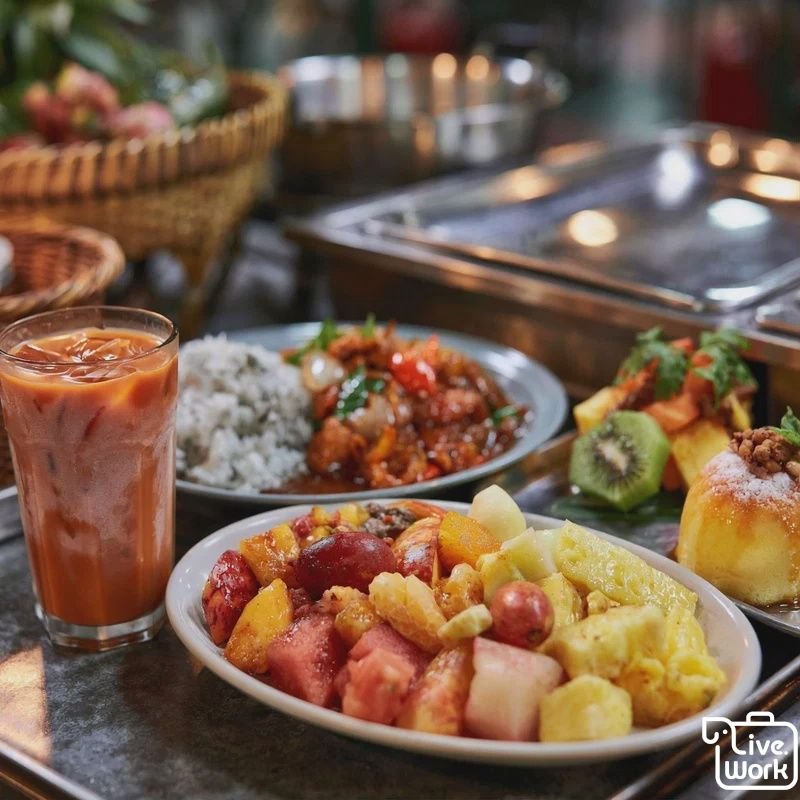
The 200-Baht Thai Market Challenge: Build a Complete Meal on a Budget
The 200-baht Thai Market Challenge turns an ordinary market visit into a practical food adventure. The mission is simple: buy one drink, one main dish, one portion of fruit, and one dessert without spending more than 200 Thai baht in total.
The challenge is not only about finding the cheapest food. A successful market meal should feel complete, with contrasting flavors and textures rather than four random purchases. A spicy or savory main can be balanced by a cold drink, fresh seasonal fruit, and a small Thai dessert. By walking between stalls, comparing prices, and keeping a running total, visitors also experience the market more actively than they would by ordering everything from the first vendor they see.
Two hundred baht can still cover a satisfying meal at many local Thai markets, particularly outside the most tourist-focused areas. However, prices vary by city, neighborhood, market type, portion size, ingredients, and season. The challenge is therefore as much about making choices as it is about finding bargains.
How the Thai Market Challenge Works
The basic rules are easy to understand. The final meal must contain four separate parts: a drink, a main dish, fruit, and dessert. Every purchase must come from stalls within the same local market, and the combined total must remain at or below 200 baht.
The drink can be Thai iced tea, coffee, fresh juice, herbal tea, coconut water, or another non-alcoholic market beverage. The main should be substantial enough to form the center of the meal, such as rice with curry, grilled chicken with sticky rice, noodles, pad kra pao, som tam with an accompaniment, or a filled omelet over rice.
The fruit should be a portion that can be eaten during or after the meal. It might be sliced pineapple, watermelon, mango, rose apple, guava, papaya, or another fruit that is available locally. The dessert can be anything from coconut pancakes and sticky rice sweets to banana roti, jelly, custard, or a small bag of traditional Thai snacks.
Keeping a running total is an essential part of the challenge. It creates the feeling of a real-life game show and prevents an early purchase from using so much of the budget that the final categories become impossible.
Start by Planning the Budget, Not the Menu
The easiest way to lose the challenge is to buy an appealing main dish immediately and think about the remaining categories afterward. Before ordering anything, walk through at least part of the market to understand what is available and how prices compare.
A simple spending plan gives each category a maximum amount while leaving a small reserve. The amounts are not fixed market prices. They are only a strategy for deciding how much of the 200-baht budget can be used at each stage.
| Meal Component | Suggested Budget Limit | Planning Strategy |
|---|---|---|
| Main dish | Allow approximately 70 to 90 baht. | Choose the main first only after comparing several filling options. |
| Drink | Allow approximately 20 to 40 baht. | Look for simple local drinks rather than oversized café-style beverages. |
| Fruit | Allow approximately 30 to 50 baht. | Choose seasonal fruit or a small ready-cut portion. |
| Dessert | Allow approximately 20 to 40 baht. | Select a small traditional sweet rather than a large specialty dessert. |
| Reserve | Keep approximately 10 to 20 baht uncommitted. | Use the reserve when one category costs slightly more than expected. |
A visitor who spends 100 baht on the main still has 100 baht for the other three categories, but the remaining choices may become limited. A main in the middle of the available price range usually provides greater flexibility and allows the meal to include better fruit or a more interesting dessert.
The reserve is particularly useful because prices may not divide neatly into the planned categories. It also protects against misunderstanding a sign, selecting a larger portion, or discovering that an ingredient costs extra.
Choosing a Main Dish That Feels Like a Full Meal
The main dish should provide enough substance to make the challenge satisfying. Rice and noodle dishes are usually practical because they combine carbohydrates, vegetables, seasoning, and often meat, tofu, or egg in one portion.
Pad kra pao, written ผัดกะเพรา and pronounced approximately “pat ga-prao,” is a popular option. It consists of minced or sliced meat stir-fried with holy basil, garlic, chilies, and savory seasoning, normally served with rice. Adding a fried egg may improve the meal but can also increase the price, so it is worth checking before ordering.
Rice-and-curry stalls are another useful choice. Known in Thai as khao gaeng, written ข้าวแกง, these stalls display prepared curries, stir-fries, vegetables, and other dishes in trays. Customers choose one or more items to be served over rice. Selecting one topping rather than several can preserve more of the challenge budget.
Noodle soups can offer excellent value because the broth, noodles, vegetables, herbs, and protein are included in a single bowl. Portions differ between stalls, so observing what other customers receive can help determine whether one bowl will be filling enough.
Grilled chicken with sticky rice creates a simple and portable main. It can also be combined with som tam, Thailand’s spicy green papaya salad, although buying several separate dishes may consume more of the budget than expected.
A successful main does not have to be the cheapest dish in the market. It should be something the participant genuinely wants to eat. The challenge is more enjoyable when it encourages discovery rather than producing a meal chosen only by price.
Balancing Spicy, Salty, Sour, and Sweet Flavors
Thai food often combines several flavor elements within the same meal. A spicy main can be balanced with something cooling, while a salty or rich dish may work well with juicy fruit or a lightly sweet dessert.
For example, a plate of spicy pad kra pao pairs naturally with an iced herbal drink or lightly sweetened tea. Grilled meat can be followed by pineapple or watermelon, whose acidity and moisture refresh the palate. A salty noodle dish may work well with a coconut-based dessert.
The drink does not need to be extremely sweet. Thai iced tea and traditional coffee can contain substantial amounts of sugar and condensed milk, which may make the complete meal feel heavier. Asking for less sweetness creates more contrast between the drink and dessert.
The Thai phrase หวานน้อย, pronounced approximately “waan noi,” means “less sweet.” It is useful when ordering tea, coffee, juice, smoothies, and other prepared drinks. The result is still based on the vendor’s normal recipe, so “less sweet” does not always mean low in sugar.
Spice can also be adjusted. เผ็ดน้อย, pronounced approximately “phet noi,” means “a little spicy” or “less spicy.” ไม่เผ็ด, pronounced “mai phet,” means “not spicy,” although dishes prepared with premade sauces or pastes may still contain some chili.
Finding a Refreshing Market Drink
A cold drink adds more than hydration to the challenge. It can change how the entire meal feels, particularly when the main is hot, spicy, or grilled.
Traditional options include Thai iced tea, black tea with lime, iced coffee, chrysanthemum tea, roselle juice, pandan drinks, sugarcane juice, and fruit smoothies. Availability differs by region and market.
Fresh coconut water can be refreshing but may use a larger share of the budget than a drink served in a plastic cup. Smoothies can also vary significantly in price depending on the fruit, cup size, and location.
Participants trying to maximize value should compare both size and ingredients. A large drink is not necessarily the better choice if it is mostly ice and syrup. A smaller herbal drink may provide a more distinctive Thai flavor while leaving more money for dessert.
Water remains the most practical choice when the main goal is food, but purchasing only bottled water can make the challenge less interesting. A locally prepared drink usually adds more personality to the final combination.
Choosing Seasonal Fruit for Better Value
Fruit is where the Thai Market Challenge changes with the season. Mango, mangosteen, rambutan, longan, lychee, pineapple, watermelon, guava, papaya, dragon fruit, rose apple, and pomelo may appear at different times and prices.
Seasonal fruit is often a better choice because it tends to be more abundant, flavorful, and competitively priced. Imported fruit or varieties that are scarce at a particular time can use a disproportionate amount of the budget.
Ready-cut fruit is convenient and allows participants to buy a small portion rather than a whole fruit. Vendors may provide a wooden stick, small fork, seasoning mixture, or dipping salt containing sugar and chili.
Whole fruit can offer better value when completing the challenge with friends, but it may be impractical for one person. Some fruits also require peeling, cutting, or opening equipment that is not available while walking around a market.
The fruit should complement the main rather than compete with it. Pineapple or guava works well after a rich meal, while watermelon is especially refreshing on a hot afternoon. Ripe mango feels sweeter and may partly replace the role of dessert, which allows the final sweet item to be smaller.
Completing the Meal with a Thai Dessert
The dessert category gives participants an opportunity to try something unfamiliar without committing to a large portion. Thai markets often sell sweets in individual pieces, small bags, boxes, banana-leaf parcels, or cups.
Khanom krok, written ขนมครก and pronounced approximately “ka-nom krok,” consists of small coconut pancakes cooked in round molds. They are usually crisp at the edges and soft in the center, with a rich coconut flavor.
Sticky rice desserts are another common choice. They may contain banana, taro, black beans, coconut milk, or sweet custard. Some are wrapped in banana leaves, making them convenient to carry.
Colorful coconut jellies, steamed cakes, fried bananas, pandan custards, and small crepes can also complete the challenge. The best option depends on what is freshly prepared and available in a portion that fits the remaining budget.
Mango sticky rice is famous, but it may be difficult to include when the other categories have already used most of the 200 baht. Choosing a smaller, traditional market sweet often creates a more varied and affordable meal.
Desserts containing coconut milk, eggs, dairy products, sesame, peanuts, or flour may not always be clearly labeled. People with food allergies should ask about ingredients and avoid items when communication is uncertain.
Useful Thai Phrases for Asking Prices
Asking prices is part of the challenge and makes the market visit more interactive. The standard Thai phrase for “How much is it?” is ราคาเท่าไหร่, pronounced approximately “raa-khaa thao-rai.”
Male speakers can add ครับ, pronounced “khrap,” and female speakers can add ค่ะ, pronounced “kha,” to make the question polite. The complete phrases are ราคาเท่าไหร่ครับ for a male speaker and ราคาเท่าไหร่คะ for a female speaker.
When pointing at an item, อันนี้เท่าไหร่, pronounced approximately “an nee thao-rai,” means “How much is this one?”
To confirm the amount, participants can repeat the number shown by the vendor or use a calculator on a phone. Many vendors will also type the price into a calculator when language is a barrier.
Once a decision has been made, เอาอันนี้, pronounced approximately “ao an nee,” means “I’ll take this one.”
Polite communication matters more than perfect pronunciation. Pointing clearly, smiling, waiting patiently, and having small cash ready will usually make the transaction easy.
How to Keep a Running Total
The challenge becomes more enjoyable when every purchase is recorded immediately. Participants can use a phone calculator, notes application, or a small piece of paper.
The total should include all optional extras. A fried egg, larger drink, added topping, special fruit seasoning, or takeaway container may affect the final amount.
Keeping the prices visible also makes the result easier to share. A completed challenge can show the market name, each item, the price paid, and the final total. This allows different combinations to be compared fairly.
A participant who finishes below 200 baht has not necessarily created a better meal than someone who spends exactly 200. Flavor, portion size, variety, and originality all matter. The budget is a limit rather than the only measure of success.
Choosing the Right Thai Market
Local morning markets, evening food markets, neighborhood fresh markets, and community walking streets can all work for the challenge. The strongest choice is usually a market with a mixture of prepared meals, drinks, fruit vendors, and dessert stalls.
A fresh market may offer inexpensive fruit and traditional food but fewer comfortable places to sit. A night market may have a wider selection of ready-to-eat dishes but somewhat higher prices, particularly in heavily visited tourist areas.
Markets near major attractions sometimes focus on visitors and may sell larger, more elaborate, or more expensive portions. Markets used regularly by local residents often provide simpler dishes and more everyday pricing.
The challenge is easiest when completed during the market’s busiest food period. Morning markets may begin closing before lunch, while some evening markets do not become fully active until late afternoon. Opening days and operating times vary and may change during holidays, festivals, or poor weather.
Before starting, participants should confirm that all four categories are available. Discovering after buying the main that the market has no fruit vendors makes the challenge unnecessarily difficult.
Market Etiquette and Respectful Bargaining
Prepared food at Thai markets is commonly sold at clearly established prices. Bargaining over a single plate of rice, cup of tea, or portion of dessert is generally unnecessary and can feel inappropriate.
The purpose of asking prices is to compare options and manage the budget, not to pressure vendors into reducing already modest food prices. It is acceptable to thank the seller and walk away politely when an item does not fit the remaining amount.
Participants should avoid touching food, fruit, utensils, or serving containers unless invited to do so. At fruit stalls, the vendor may prefer to select and weigh the produce.
Queues are not always physically marked, but customers generally notice who arrived first. Watching how others order can make the process smoother, especially at busy stalls.
Taking photographs of food is usually uncomplicated, but photographing vendors closely should be done respectfully. Asking permission is appropriate when a person will be the clear subject of the image or video.
Food Hygiene and Practical Safety
A busy stall can be a positive sign because food is prepared and sold quickly. High turnover reduces the time cooked dishes remain at room temperature.
For hot food, dishes that are freshly cooked or kept properly heated are generally preferable. Cold food should appear protected and adequately chilled. Raw ingredients should be kept separate from cooked items.
Fruit cut in advance should look fresh and be stored away from direct heat, insects, and road dust. Participants with sensitive stomachs may prefer fruit that is peeled or cut after ordering.
Handwashing facilities are not available at every market. Carrying hand sanitizer or wipes can make eating more comfortable, particularly when handling cash between courses.
Food containing raw seafood, undercooked meat, or ingredients that have been sitting in strong heat requires more caution. The challenge should encourage exploration, not pressure participants into eating something that appears poorly handled.
Adapting the Challenge for Vegetarian Diets and Allergies
Vegetarian participants can build a full meal, but communication may require more than asking whether a dish contains visible meat. Thai sauces and broths may contain fish sauce, oyster sauce, shrimp paste, meat stock, or dried seafood.
The phrase กินเจ, pronounced approximately “gin jay,” refers to a stricter Thai vegan-style diet that excludes animal products and also traditionally avoids certain strong-smelling vegetables. Stalls displaying a yellow flag with red Thai characters may specialize in jay food, particularly during the annual Vegetarian Festival.
The phrase มังสวิรัติ, pronounced approximately “mang-sa-wi-rat,” means vegetarian, but individual interpretations can vary. It is still sensible to ask about fish sauce, oyster sauce, egg, and broth when these ingredients matter.
Food allergies are more difficult because shared woks, utensils, grills, oils, and preparation surfaces are common in markets. Anyone with a severe allergy should not rely only on visual inspection or assume that removing a topping eliminates cross-contact.
A successful challenge should match the participant’s dietary needs. There is no benefit in staying under budget if the final meal is unsuitable or unsafe to eat.
Common Mistakes During the 200-Baht Challenge
Buying an expensive drink first is a frequent mistake. Large smoothies, specialty coffees, and novelty beverages can consume money that would be more useful for the main dish.
Another mistake is purchasing four items that are all sweet or heavy. Thai iced tea, ripe mango, coconut dessert, and a sweetened main sauce may fit the rules but create an unbalanced meal.
Participants also forget to ask whether extras cost more. A fried egg, additional rice, takeaway packaging, or premium topping may push the final total over 200 baht.
Choosing fruit before seeing the available portion sizes can create difficulties. A whole premium fruit may be more than one person needs, while a small cut portion may complete the category more efficiently.
The challenge should not encourage food waste. Buying an unusually large meal simply because it remains under budget defeats the purpose. Portions should be realistic for the number of people taking part.
A Sample Market Challenge Strategy
A practical approach is to begin with a full walk through the market and identify two possible choices in each category. The main should then be selected based on both appetite and price.
After buying the main, calculate the exact remaining budget before choosing the drink. If the main is spicy or heavily seasoned, prioritize a refreshing drink rather than the largest available serving.
Fruit should come next because its price and portion size can vary more than expected. The dessert can then be chosen using the exact amount left.
This order leaves the most flexible category until last. Thai dessert stalls often offer several small items, making it easier to finish the challenge without exceeding the limit.
A meal might combine a basil stir-fry over rice, iced roselle juice, sliced pineapple, and coconut pancakes. Another participant might choose noodle soup, black tea with lime, guava, and a banana-leaf sticky rice sweet. The strongest combinations are those that reflect the individual market rather than copying a fixed menu.
Turning the Challenge into a Group Game
The 200-baht Thai Market Challenge works especially well with friends, families, or small travel groups. Each person can receive the same budget and build a different meal within the same market.
The final combinations can be judged by taste, value, variety, creativity, presentation, or how strongly they represent local food. One participant may prioritize a large main, while another may choose smaller dishes to leave room for an elaborate dessert.
Sharing bites can make the experience more social, but each entry should still meet the original four-category requirement. Participants should also agree in advance whether shared items, free drinking water, or promotional discounts are allowed.
The objective is not to compete aggressively or inconvenience vendors. The game works best when it encourages conversation, curiosity, and appreciation for the range of affordable food found in Thai markets.
Conclusion
The 200-baht Thai Market Challenge is a simple way to explore Thai food with more purpose. By finding one drink, one main dish, one fruit, and one dessert within a fixed budget, visitors pay closer attention to prices, portion sizes, seasonal ingredients, and the way different flavors fit together.
The most effective strategy is to inspect the market before buying, reserve the largest share of the budget for the main, and keep a small amount available for unexpected costs. A spicy or savory dish, refreshing drink, fresh fruit, and small traditional dessert usually create the most balanced result.
Prices and availability differ between markets, cities, seasons, and tourist areas, so no single combination will work everywhere. That variation is part of the appeal. Every market creates a new version of the challenge and an opportunity to discover a dish, fruit, or sweet that might otherwise have been overlooked.
A successful entry does not need to use every last baht. It needs to produce a satisfying meal, respect the vendors, avoid food waste, and show how much variety can be found by exploring a Thai market one stall at a time.