How to Send Documents and Parcels with Thai Post: A First-Timer’s Guide to Boxes, Registered Mail, EMS, Customs, Packing, and Tracking
Sending documents, gifts, personal belongings, or online sales parcels from Thailand is much easier once you understand the basic flow. Thai Post, officially known as Thailand Post, has branches across the country and offers services for simple domestic letters, tracked documents, express parcels, international shipments, e-commerce orders, and larger packages. For a newcomer, however, the number of service names, forms, counters, boxes, labels, and customs questions can make the first visit feel more complicated than it really is.
The basic process is straightforward. First, decide what you are sending and whether it is going somewhere in Thailand or abroad. Next, choose suitable packaging and protect the contents properly. At the post office, the parcel or envelope is weighed, the available services are explained, and the price is calculated according to the destination, service, weight, and sometimes the size or category of the shipment. You then receive a receipt containing the shipment number if you selected a tracked service. Keep that receipt until delivery has been confirmed.
The most important decision is not simply whether to choose the cheapest or fastest option. You should match the service to the value, urgency, and importance of the contents. A simple document may need only a basic postal service. An important contract may justify registered or express handling. A time-sensitive parcel may be better suited to EMS. A lower-value international parcel may fit a slower standard service. The correct choice depends on what you are sending, how quickly it needs to arrive, whether tracking is essential, and how much financial risk you are comfortable accepting.
Good packing matters just as much as choosing the service. A strong box, sealed seams, internal cushioning, a clear address, and honest customs information can prevent many common problems. Most stressful postal experiences begin before the parcel reaches the counter: weak packaging, incomplete addresses, loose items inside a box, prohibited contents, missing recipient phone numbers, or unrealistic expectations about customs and delivery times.
With a little preparation, Thai Post becomes a practical everyday service rather than an unfamiliar system.
Understanding the Basic Thai Post Process
A typical visit begins with your item already packed or partly prepared. Many post offices sell envelopes, padded mailers, cartons, tape, and other postal materials, so it is possible to arrive with an unpacked item and prepare it there. However, packing at home is often calmer, especially when the contents are fragile, valuable, unusually shaped, or need careful organization.
When you reach the branch, look for the queue system. Larger branches may have ticket machines or separate service areas, while small neighborhood branches may use a simple first-come, first-served counter. Keep your parcel accessible because staff may need to inspect the packaging, confirm the type of contents, or ask questions before accepting it.
At the counter, explain whether the shipment is domestic or international. Show the address and describe the contents clearly. The postal officer will normally weigh the item and may measure it if size affects the service. You can then ask which options are available.
For a domestic parcel, the conversation may be as simple as choosing between a standard tracked service and EMS. For an international shipment, the process may include a customs declaration, a more detailed description of the contents, the declared value, the destination country, and questions about restricted items.
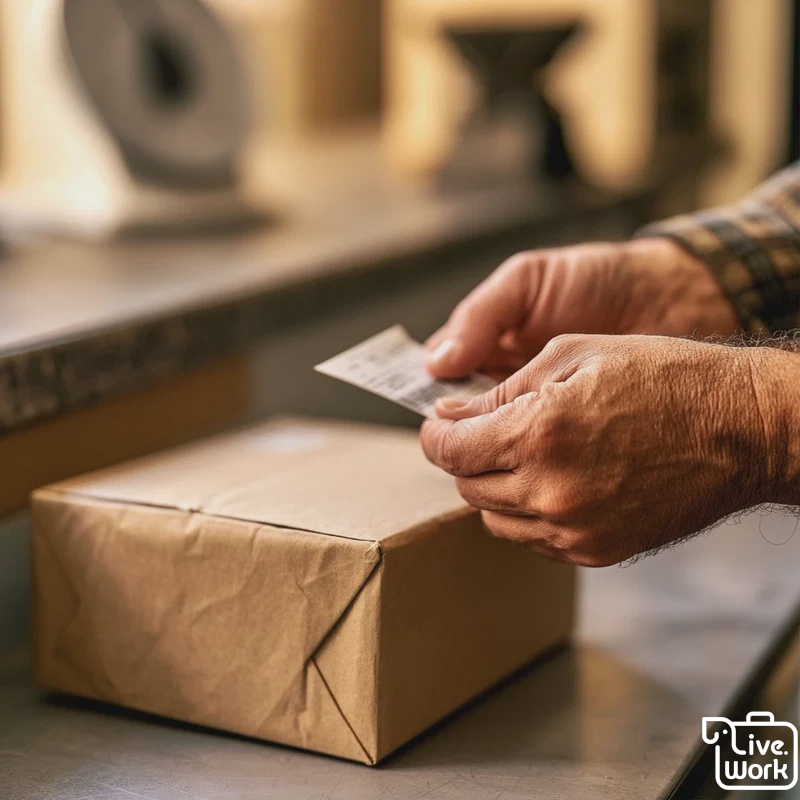
Once the service is selected, you pay the postage and receive a receipt. For tracked services, the receipt includes a shipment or tracking number. That code is one of the most important parts of the transaction. Photograph the receipt immediately and keep the original until the parcel has arrived.
Choosing Between an Envelope, Padded Mailer, and Box
Packaging should match the item rather than simply being the smallest container available.
A standard paper envelope is appropriate for ordinary documents that do not need protection from bending. Important paperwork should usually be placed inside a plastic document sleeve or internal protective folder before going into the outer envelope. This adds protection against moisture and accidental tearing.
A rigid document envelope is better for certificates, signed agreements, photographs, official papers, and documents that should remain flat. If the document is irreplaceable, make a digital copy before sending it and consider whether the original really needs to be posted.
A padded envelope works well for small, non-fragile objects such as accessories, fabric items, cables without batteries, small packaged products, or lightweight online orders. The padding protects against scratches and minor impacts but should not be treated as sufficient protection for fragile objects.
A cardboard box is the best choice for gifts, multiple items, products, household objects, books, clothing, electronics accepted under the selected service conditions, and anything that could be crushed inside an envelope. The box should be strong enough to remain rigid when pressed lightly from the sides.
Do not use an oversized box simply because it is available. Too much empty space allows items to move and can increase the risk of damage. At the same time, do not force objects into a box that is too small. A tightly stretched or bulging carton can split during sorting or transport.
Packaging Comparison
| Packaging Type | Best For | Main Packing Advice |
|---|---|---|
| Standard Envelope | Letters, ordinary paperwork, printed forms, and documents that can tolerate normal handling. | Place important papers inside an internal plastic sleeve and avoid overfilling the envelope. |
| Rigid Document Envelope | Certificates, contracts, official papers, photographs, and documents that should not bend. | Use cardboard support where appropriate and keep a scanned copy of important originals before posting. |
| Padded Mailer | Small accessories, lightweight products, fabric items, and objects needing scratch protection. | Do not rely on the padding alone for fragile items; add internal protection when necessary. |
| Cardboard Box | Gifts, merchandise, clothing, books, household items, multiple products, and fragile objects. | Use a strong box, fill empty space, protect individual items, and tape every major seam securely. |
| Double Box | Fragile, heavy, valuable, or unusually sensitive items. | Place the protected inner box inside a larger outer box with cushioning on every side. |
Which Thai Post Service Should You Choose?
The best service depends on four questions.
How quickly must the item arrive?
How important is end-to-end tracking?
How valuable or difficult to replace is the item?
Are you sending documents or physical goods?
For everyday domestic shipments, ask the counter staff to explain the available standard tracked and EMS options. Domestic service names, rates, delivery standards, and promotions can change, so the counter quotation is more useful than relying on an old price remembered from a previous shipment.
For important documents, choose a service that provides proof of posting and tracking. Registered Mail is commonly associated with documented acceptance and a shipment number, but the exact service conditions differ between domestic and international mail. International Registered Mail is designed specifically for documents and has its own size and weight limits. It should not be treated as a general merchandise parcel service.
EMS is the express option most newcomers recognize. Domestic EMS is commonly used for faster shipments inside Thailand, while EMS World is used for eligible international documents and merchandise. Express service is useful when speed, tracking, and delivery confirmation matter more than obtaining the lowest price.
International Parcel is designed for general outbound parcels and can be more suitable for larger or heavier shipments when express speed is not essential. Other international options may also be available depending on the destination, package, value, and current postal network.
The postal officer can compare available choices after the item has been weighed. Instead of asking only, “What is cheapest?”, explain the outcome you need. Say that the document is important, the parcel contains online sales goods, the item is a gift, or the delivery is urgent. Clear priorities lead to a better recommendation.
Thai Post Service Comparison
| Service Type | Best Use | What to Consider |
|---|---|---|
| Ordinary Mail | Low-value letters and documents where the lowest cost matters more than detailed tracking. | Tracking or proof of delivery may be limited or unavailable, so avoid using it for irreplaceable originals. |
| Registered Mail | Important documents where proof of posting, a shipment number, and documented handling are useful. | International Registered Mail is a document service with specific weight and size limits rather than a general goods service. |
| Domestic EMS | Urgent documents and parcels sent within Thailand when faster delivery and tracking are important. | Ask the branch for the current rate and expected delivery standard for the destination postcode. |
| EMS World | Time-sensitive international documents and merchandise requiring express transport and tracking. | Customs processing can still affect the final delivery time, and destination restrictions continue to apply. |
| International Parcel | General overseas parcels where a standard service may be more economical than express shipping. | Delivery may take longer, and available transport methods depend on the destination country. |
| Other International Services | Small packets, e-commerce orders, lower-value goods, or destination-specific shipping needs. | Availability, tracking coverage, weight limits, and delivery standards vary, so compare current options at the branch. |
Sending Important Documents
Important documents deserve more preparation than ordinary correspondence.
Before posting a contract, certificate, academic record, legal paper, immigration document, official form, or original signed agreement, scan every page. Save the file somewhere secure and confirm that the scan is readable. If the document has signatures, stamps, seals, attachments, or supporting pages, check that all of them appear in the copy.
Place the papers inside a clear protective sleeve. This provides basic resistance against moisture and keeps several pages together. Use a rigid or reinforced outer envelope when bending could cause damage.
Write the recipient address clearly and completely. Include the recipient’s full name, building or house number, street or soi, subdistrict where relevant, district, province, postcode, country for international mail, and a working phone number where appropriate.
For important domestic paperwork, ask the postal officer which tracked proof-of-posting service is most suitable. For important international documents, ask whether Registered Mail or EMS World better matches the urgency, weight, destination, and value.
Registered Mail may be appropriate when the document is important but express speed is not essential. EMS may be more appropriate when timing is critical. The faster option is not automatically the safer decision for every document, and the cheaper option is not automatically sufficient. Consider replacement difficulty. If losing the original would create serious problems, use a service with suitable tracking and keep copies.
Writing the Address Correctly
A clear address helps prevent delays.
For shipments inside Thailand, the recipient’s name should appear first. Below it, write the building name, room number, house number, village number if applicable, soi, road, subdistrict, district, province, and five-digit postcode. Add a phone number when possible because it can help with delivery questions.
Many people in Thailand use Thai-language addresses, English-language addresses, or both. When a recipient gives you an address in Thai, copying it exactly can reduce transliteration mistakes. You can place the English version beside or below it if useful.
For international shipments, write the destination address in clear Roman letters unless the destination postal system requires another format. Put the destination country in capital letters on the final line. Include a valid postal code and avoid using an incomplete address such as only a person’s name and city.
Write the sender address clearly as well. A return address is important if delivery fails, the recipient cannot be found, customs rejects the shipment, or the parcel is returned.
Do not place the address over a box seam, heavily taped area, or curved surface. The label should remain flat and readable. Covering a paper address label with clear tape may protect it from moisture, but do not obscure barcodes or postal labels added by the branch.
A Clear Address Structure
| Address Element | Why It Matters | Practical Advice |
|---|---|---|
| Recipient Name | Identifies the intended person or business receiving the shipment. | Use the full name or registered business name rather than only a nickname. |
| Building, Room, or House Number | Directs the delivery worker to the exact property or unit. | Include condominium names, floor numbers, office units, and room numbers where relevant. |
| Soi, Road, and Local Area | Provides the local route information needed to locate the address. | Copy the spelling supplied by the recipient and avoid guessing transliterations. |
| District, Province, and Postcode | Routes the item through the correct postal network. | Double-check the postcode because one incorrect digit can send the parcel to the wrong sorting area. |
| Country | Identifies the international destination. | Write the country clearly in capital letters on the final line of an overseas address. |
| Phone Number | Can help the delivery service contact the recipient if access or address clarification is needed. | Use a current number and include the country code for international recipients when appropriate. |
| Sender Address | Allows the item to be returned if delivery is unsuccessful. | Use an address where you can actually receive a returned parcel for the expected shipping period. |
Packing a Parcel Properly
Good packaging protects against vibration, pressure, stacking, drops, movement, and moisture. A parcel may pass through several vehicles, sorting points, conveyor systems, storage areas, and delivery rounds before reaching the recipient. It should be packed for transport rather than only for appearance.
Begin with a sturdy box. Reused boxes can be acceptable when they remain strong, dry, and undamaged. Remove or cover old shipping labels and barcodes because they can confuse automated sorting.
Wrap fragile objects individually. Bubble wrap is useful because it absorbs impact and prevents direct contact between items. Use multiple layers for glass, ceramics, electronics, or objects with delicate corners.
Fill empty space. Shaking the sealed box gently should not produce obvious movement. Use packing paper, air cushions, bubble wrap, cardboard inserts, foam, or another clean protective material. Avoid relying on loose thin plastic bags because they compress easily and provide little impact protection.
Protect sharp corners. Even ordinary objects can damage their own packaging if pressure concentrates at one point. Add cardboard reinforcement or extra cushioning around edges.
Seal the box using strong packing tape. Tape the central seam and the side seams. A single strip across the top is often not enough. Reinforce the bottom, especially for books, dense products, or other heavy contents.
Do not wrap a box in string. String can catch in sorting equipment. Do not use decorative ribbon as the main closure. A gift can look attractive inside the shipping carton, but the external packaging should prioritize strength.
Packing Different Types of Items
| Item Type | Main Risk | Recommended Packing Approach |
|---|---|---|
| Documents | Bending, tearing, moisture, missing pages, and damaged corners. | Use a plastic document sleeve inside a strong envelope and add rigid backing for important originals. |
| Books | Corner damage, moisture, and box failure caused by concentrated weight. | Wrap the books, use a strong closely fitted box, and reinforce the bottom seams carefully. |
| Clothing | Moisture, dirt, excess package volume, and accidental cutting when opened. | Place clothing inside a sealed internal bag, remove excess air carefully, and use a mailer or box with enough room. |
| Glass or Ceramics | Impact, vibration, pressure, and contact between separate pieces. | Wrap each item individually, cushion every side, fill all empty space, and consider double boxing. |
| Online Sales Products | Presentation damage, movement, customer disappointment, and unclear product identification. | Protect the retail product inside a separate shipping package and include the order information without exposing unnecessary personal data. |
| Gifts | Decorative wrapping tearing during transport and customs needing access to the contents. | Place the wrapped gift inside a protective shipping carton and avoid sealing it in a way that prevents required inspection. |
| Several Small Items | Items striking one another, disappearing into empty space, or shifting during sorting. | Wrap items separately, group them in internal bags or small boxes, and fill remaining space securely. |
Fragile Labels Are Not a Substitute for Good Packing
Writing “FRAGILE” on a box can communicate useful information, but it does not guarantee gentle handling. The internal packaging must protect the item even if the box is stacked, moved quickly, tilted, or experiences normal transport impacts.
Imagine the parcel being placed under other parcels. Imagine it being turned upside down. Imagine it being carried through rain for a short distance. If the contents would fail under those conditions, improve the packaging.
For fragile items, leave enough cushioning between the object and every outer wall. The item should not touch the cardboard directly. If several fragile objects are inside, they should not touch one another.
Photograph the packing process for higher-value shipments. Take a picture of the item before wrapping, the protective layers, the open box, and the sealed package. These photographs may be useful if damage occurs and can also help you improve future packing.
Sending Parcels Within Thailand
Domestic shipping is generally the simplest use of Thai Post.
Prepare the recipient’s complete Thai address and phone number. Pack the item securely. At the branch, tell the postal officer that the parcel is going within Thailand and ask for the available tracked options.
For routine online sales, gifts, clothing, household items, or documents, compare standard tracked delivery with EMS. EMS may be useful when faster delivery is important. A standard service may be sufficient when price matters more and the delivery is not urgent.
Rates are normally based on the selected service and the shipment characteristics. The parcel is weighed at the counter, so a small difference in packing materials can affect the price when it moves the parcel into another weight bracket.
Do not assume the delivery time is identical for every location. Central urban destinations, islands, remote villages, border areas, and some rural districts may require different transit times. Public holidays, severe weather, flooding, address problems, or unusually high parcel volumes can also affect delivery.
Keep the receipt until the recipient confirms arrival. Do not discard it simply because tracking shows the parcel has entered the postal network.
Sending International Parcels
International shipping requires more information because the parcel crosses a customs border.
Bring the complete recipient address, destination postcode, country, and phone number. Carry your passport or another appropriate identification document as a practical precaution, particularly when sending internationally or completing sender and customs information. Requirements can depend on the service, branch procedure, contents, and current regulations.
The postal officer will ask what is inside the parcel. Give a simple but specific description. “Gift” alone explains the purpose, not the contents. “Clothes” is better. “Two cotton shirts” is better still. “Accessories” is vague. “Three fabric keychains” is clearer.
Describe the actual contents honestly. Do not label commercial products as documents. Do not describe a valuable product as having no value merely to reduce the chance of import tax. Incorrect declarations can create delays, seizure, return, penalties, or insurance problems.
You may need to state the quantity, weight, value, purpose, and category of the contents. Depending on the service, the shipment may be identified as documents, business papers, a gift, a sample, or merchandise.
The receiving country may charge import duties, taxes, handling fees, or customs charges. Paying postage in Thailand does not automatically pay the destination country’s import charges. The recipient may be responsible for those costs.
Customs can also delay a shipment even when the postal journey itself is fast. An express estimate is not a guarantee that customs will release the parcel immediately.
International Customs Declaration Guide
| Customs Information | Good Example | What to Avoid |
|---|---|---|
| Description of Contents | “Two cotton T-shirts” or “three printed books.” | Descriptions such as “stuff,” “personal things,” “miscellaneous,” or another vague category. |
| Quantity | The actual number of items contained in the shipment. | Leaving the quantity blank or grouping unrelated goods inaccurately. |
| Declared Value | A reasonable and truthful value based on the goods being sent. | Declaring an unrealistically low value only to try to avoid destination taxes. |
| Purpose | Gift, merchandise, sample, returned goods, or another accurate purpose. | Calling a commercial online sale a personal gift when it is actually merchandise. |
| Recipient Information | Full name, complete address, postcode, country, and working contact details. | Incomplete addresses, missing apartment numbers, or an outdated phone number. |
| Supporting Documents | Invoice, receipt, product information, or other documents where required. | Assuming no paperwork is needed for commercial goods or restricted categories. |
Gifts and Online Sales Parcels Are Not Always Treated the Same
A gift is an item sent without a commercial sale between the sender and recipient. Merchandise is connected to a commercial transaction. Product samples may have a separate purpose and documentation.
The distinction matters because customs authorities may assess the shipment differently. Simply writing “gift” does not guarantee that the recipient will avoid tax. Each destination country has its own import rules, value thresholds, restrictions, documentation requirements, and customs practices.
For an online sale, keep basic transaction records. Depending on the destination and product type, an invoice or commercial information may be needed. Describe the product accurately and use a realistic value.
Online sellers should also think beyond postage price. Packaging cost, possible returns, customer delivery expectations, tracking coverage, compensation limits, customs delays, and destination charges all affect the real shipping experience.
Before promising an international customer a delivery date, check the current service conditions for the destination. Postal availability and customs processing can change.
Restricted and Prohibited Items
Not every ordinary household object can automatically be sent through every postal service.
Air transport rules, Thai law, Thailand Post conditions, destination-country rules, customs regulations, and airline safety requirements can all affect acceptance.
Some clearly prohibited categories include dangerous substances, explosives, flammable materials, certain weapons, illegal items, live animals, and other goods that create safety or legal risks. Some apparently normal items require special attention. Batteries, devices containing batteries, liquids, aerosols, sharp objects, machinery, chemicals, cosmetics, food, medicine, plants, seeds, and products containing restricted materials may have special conditions or may be refused depending on the destination and transport method.
Do not hide a restricted item inside an ordinary description. If you are unsure, leave the package open and ask the postal officer before sealing it fully. Show the item or its product information. It is better to receive a clear answer at the counter than to have the parcel stopped later.
Destination rules matter as much as Thai acceptance rules. An item may be allowed to leave Thailand but restricted from entering the receiving country.
For international shipping, check the destination’s customs rules when sending food, supplements, cosmetics, medicine, plant products, electronics, high-value goods, or commercial quantities.
Why Batteries and Liquids Need Extra Attention
Many travelers assume that a small electronic device can be shipped like clothing. That is not always true. Lithium batteries and devices containing batteries are controlled in air transport because damaged or incorrectly packed batteries can create fire risks.
Liquids can also create problems. Some services restrict them, require inspection, or apply special conditions. A leaking liquid can damage many other postal items.
Do not describe a battery-powered device merely as “electronics” and hope it passes. Tell the postal officer exactly what it is and whether the battery is installed, removable, separate, rechargeable, or absent.
Likewise, identify liquids honestly. Perfume, oils, cosmetics, sauces, cleaning products, and other liquid items may not be accepted under the service you first intended to use.
What to Do Before Sealing an International Parcel
Before closing the box permanently, confirm the following information mentally.
You know every item inside.
You can describe each item accurately in English when required.
You know the approximate value.
You have checked whether any item contains a battery, liquid, chemical, medicine, food, plant material, or restricted component.
You have the recipient’s full address and phone number.
You have added enough internal protection.
You understand that customs may inspect the shipment.
You accept that destination taxes or fees may be charged.
Although this is a simple mental check rather than a complicated procedure, it prevents many problems at the counter.
Paying by Weight
Postal rates are generally connected to service, destination, and shipment characteristics. Weight is one of the most important factors.
The post office weighs the complete shipment, including the box, tape, bubble wrap, labels, and all internal packaging. This means a lightweight product in a heavy oversized box may cost more than expected.
Pack efficiently but do not sacrifice protection merely to save a small amount. Replacing a damaged item usually costs more than using appropriate cushioning.
For international shipments, service availability and pricing may differ by destination. Two parcels with the same weight can have different prices when sent to different countries.
Ask for a comparison when useful. The counter may be able to explain a faster tracked service, a standard tracked service, and a more economical option. Compare not only the price but also estimated transit time, tracking, compensation, service availability, and weight limits.
Tracking Your Shipment
After paying, examine the receipt before leaving the branch.
Find the shipment number. Tracked Thai Post items commonly use an alphanumeric code printed on the receipt or label. Enter the code into the official Thailand Post tracking system.
Tracking may show stages such as acceptance, processing, dispatch, arrival at a sorting center, international departure, customs processing, delivery attempt, successful delivery, or return.
Do not panic if the status does not change immediately. A parcel may move physically before the next electronic scan appears. International tracking can also pause between departure from Thailand and entry into the destination postal system.
Take a clear photograph of the receipt because thermal receipt printing can fade over time. Save the tracking number as text so you do not need to read it repeatedly from the image.
For an online sale, send the tracking number to the customer and explain that international customs can affect delivery timing. For personal shipments, send the number to the recipient so both sides can follow progress.
Keep the original receipt until delivery is confirmed and enough time has passed to resolve any issue.
Understanding Common Tracking Updates
| Tracking Stage | What It Usually Means | What You Should Do |
|---|---|---|
| Accepted or Posted | The post office has received the item and created the shipment record. | Check that the tracking number works and keep the receipt safely. |
| Processing or Sorting | The shipment is moving through a postal facility or preparing for onward transport. | Allow normal processing time and avoid treating every short pause as a problem. |
| Dispatched | The item has left a facility for another sorting center, transport hub, or destination country. | Continue monitoring without expecting an immediate delivery scan. |
| Customs Processing | The shipment is being reviewed under the destination country’s import procedures. | The recipient may need to provide information or pay duties, taxes, or fees. |
| Out for Delivery | The item has entered the local delivery process. | Make sure the recipient is reachable and can access the delivery location. |
| Delivery Attempted | The delivery worker could not complete delivery or requires another action. | The recipient should check notices, contact the local postal service, or arrange collection where required. |
| Delivered | The postal system records the item as delivered. | Confirm directly with the recipient before discarding the shipping receipt. |
| Returned to Sender | Delivery could not be completed or the shipment was rejected, unclaimed, or otherwise returned. | Review the tracking reason and contact the postal service if further explanation is needed. |
Keep the Receipt Until Delivery Is Confirmed
The receipt is your evidence that the item was accepted. It normally identifies the service, date, branch, amount paid, and shipment number.
Do not discard it after sending a screenshot to the recipient. Do not leave it loose in a pocket where the printing may be damaged. Store it flat or photograph it.
For business shipments, connect the receipt to the customer order. Record the shipment number, date, destination, service, shipping cost, and order reference. This makes customer service and accounting easier.
If a parcel is delayed, lost, damaged, or returned, the receipt may be needed when contacting Thailand Post or submitting an inquiry.
Finding a Thai Post Branch
Thailand Post has branches and service points throughout the country. Larger central branches may offer broader services, longer operating hours, more packing materials, and staff with greater experience handling international parcels. Smaller neighborhood branches are often faster and more convenient for routine domestic shipments.
Operating hours differ by location. Some branches open on weekends, while others do not. Branch hours can change on public holidays.
For a first international shipment, a larger branch may be easier because staff regularly handle customs forms and multiple international services. For a simple domestic letter or parcel, the nearest local branch may be completely sufficient.
Arrive with enough time. International customs paperwork, repacking, service comparisons, queues, and item inspection can take longer than expected.
A Step-by-Step First Visit
| Stage | What to Do | Why It Matters |
|---|---|---|
| Before Leaving Home | Check the address, copy important documents, pack the contents, and identify any batteries, liquids, food, or restricted materials. | Preparation reduces delays and prevents repacking or service refusal at the branch. |
| At the Branch | Take a queue number if required and keep the parcel accessible for inspection or weighing. | The postal officer may need to confirm the contents and packaging before accepting the shipment. |
| Choose the Service | Explain whether speed, low cost, tracking, proof of posting, or delivery confirmation matters most. | The best service depends on your priorities rather than only the parcel weight. |
| Complete the Information | Provide the sender and recipient details and complete customs information honestly for international goods. | Accurate information reduces customs problems, delivery delays, and return risk. |
| Pay and Check the Receipt | Confirm the service and locate the tracking number before leaving the counter. | Correcting a misunderstanding immediately is easier than discovering it later. |
| Track the Shipment | Photograph the receipt, save the shipment number, and monitor the official tracking system. | The tracking history helps both sender and recipient understand the shipment’s progress. |
| After Delivery | Confirm with the recipient that the parcel arrived safely before discarding the original receipt. | A delivered tracking scan does not always confirm that the intended person has personally checked the contents. |
Common First-Timer Mistakes
One of the most common mistakes is arriving with an incomplete address. A missing room number, postcode, district, recipient phone number, or country detail can create avoidable delays.
Another mistake is sealing an international parcel before checking whether the contents are accepted. If the parcel contains batteries, liquids, food, medicine, cosmetics, plant products, sharp objects, or unusual goods, the postal officer may need more information.
Weak packaging is another frequent problem. A thin reused box with one strip of tape may look sufficient at home but fail during transport. Reinforce seams and protect the contents internally.
Some senders choose ordinary mail for irreplaceable documents because it is inexpensive. The postage saving may not justify the risk when tracking or proof of posting is important.
Another mistake is declaring customs contents too vaguely. “Gift” describes the purpose, not the product. A useful declaration identifies what the gift actually contains.
Finally, many people lose the receipt. The moment after payment is the best time to photograph it.
Thai Phrases That Can Help at the Post Office
You can complete most postal transactions without speaking fluent Thai, especially when you have the address written clearly and can show the parcel. A few phrases may still make the visit easier.
“ส่งในประเทศไทย” means “send within Thailand.”
“ส่งไปต่างประเทศ” means “send abroad.”
“ลงทะเบียน” refers to registered service.
“อีเอ็มเอส” refers to EMS.
“มีเลขติดตามไหม” means “Is there a tracking number?”
“ใช้เวลากี่วัน” means “How many days does it take?”
“ราคาเท่าไหร่” means “How much is it?”
You do not need perfect pronunciation. Show the written phrase, point to the address, and communicate the main priority clearly.
Useful Thai Post Office Phrases
| Thai Phrase | Approximate Pronunciation | Meaning |
|---|---|---|
| ส่งในประเทศไทย | Song nai prathet Thai | Send within Thailand. |
| ส่งไปต่างประเทศ | Song pai tang prathet | Send abroad. |
| ส่งลงทะเบียน | Song long thabian | Send by registered mail. |
| ส่งอีเอ็มเอส | Song EMS | Send by EMS. |
| มีเลขติดตามไหม | Mee lek tit tam mai | Is there a tracking number? |
| ใช้เวลากี่วัน | Chai wela gee wan | How many days does it take? |
| ราคาเท่าไหร่ | Rakha thao rai | How much is it? |
| ขอบคุณครับ/ค่ะ | Khop khun khráp/khâ | Thank you. |
Sending Online Sales Orders
Thai Post is widely used by small businesses and online sellers because branches are easy to find and multiple domestic and international services are available.
Create a repeatable packing process. Use consistent box sizes where practical, keep tape and protective material ready, print or write addresses clearly, and connect each tracking number to the correct order.
Before sealing the parcel, verify the customer’s name, product, quantity, address, postcode, and phone number. Many shipping mistakes are order-management mistakes rather than postal mistakes.
Protect the retail product from the outer shipping environment. A customer should not receive a product covered directly in tape or damaged because the decorative packaging was used as the shipping box.
For higher-volume selling, compare the cost and workflow of different Thai Post services rather than automatically choosing EMS for every order. Some customers value speed. Others value lower shipping costs.
Set realistic expectations. “Shipped today” does not mean “arriving today.” Explain the selected service and provide tracking promptly.
For international sales, state clearly that customs duties or destination fees may be the customer’s responsibility unless your sales terms specify another arrangement.
When EMS Is Worth the Extra Cost
EMS is useful when time matters, tracking matters, or the shipment has greater practical importance.
A signed contract needed before a deadline may justify EMS. A replacement item for a waiting customer may justify EMS. A time-sensitive personal document may justify EMS.
However, express postage cannot eliminate customs delays, incorrect addresses, recipient absence, severe weather, or destination restrictions. EMS improves the transport service but does not control every part of the delivery chain.
For low-value non-urgent items, a standard tracked service may offer better value. Ask the postal officer to compare the current options.
When Registered Mail Makes Sense
Registered Mail is useful when documentation matters more than the fastest possible delivery.
An important letter, signed form, business document, certificate copy, or other paperwork may justify registered handling because you receive evidence of posting and a shipment number.
For international service, confirm that the item meets the document-only conditions, weight limit, size limit, and destination availability.
Do not put merchandise inside a document envelope and assume that international Registered Mail will accept it. Choose a service designed for goods.
When an International Parcel Service May Be Better
A standard international parcel service may be more suitable when the shipment contains goods, is larger, and does not require express delivery.
This can apply to clothing, gifts, books, household items, personal belongings, or merchandise that fits the service conditions.
The trade-off is time. A lower-cost service may take longer and may have different tracking, compensation, or transport standards. Compare these before paying.
Do not rely on one universal delivery estimate for every country. Destination, customs, local postal conditions, transport route, and service type all matter.
Customs Delays Are Not Always Postal Delays
When an international parcel stops updating after reaching the destination, the postal service is not necessarily the cause. Customs may need to examine the parcel, assess tax, verify documents, contact the recipient, or apply a destination-country rule.
The recipient should watch for messages, letters, emails, calls, or online customs notifications. A parcel can remain uncollected if the recipient does not respond.
The sender should provide accurate customs information from the beginning. Clear descriptions and realistic values make processing easier, although they cannot guarantee immediate release.
A Practical Pre-Shipping Checklist
| Check | What to Confirm | Why It Matters |
|---|---|---|
| Contents | You know exactly what is inside and whether any item has special restrictions. | Postal and customs declarations must match the actual shipment. |
| Packaging | The box or envelope is strong, sealed, dry, and appropriate for the item. | Good packaging reduces damage and prevents the parcel from opening during transport. |
| Internal Protection | Items cannot move freely and fragile objects are cushioned on every side. | Most transport damage occurs because movement or impact reaches the contents. |
| Recipient Address | The full name, street details, district, province, postcode, country, and phone number are correct. | A complete address is essential for routing and final delivery. |
| Sender Address | The return address will remain valid during the expected shipping period. | Undeliverable items may need to return to the sender. |
| Customs Information | The description, quantity, value, and purpose are truthful and specific. | Incorrect declarations can delay or disrupt international delivery. |
| Service Choice | The speed, tracking, cost, and compensation level match the importance of the item. | The cheapest service is not always suitable, and the fastest service is not always necessary. |
| Receipt | You have photographed and safely stored the receipt and tracking number. | The receipt supports tracking, customer communication, and possible postal inquiries. |
Final Advice for a Stress-Free Thai Post Visit
Prepare before you arrive.
Write or print the address clearly.
Pack for real transport, not only for appearance.
Keep international parcels accessible if inspection may be needed.
Describe customs contents honestly and specifically.
Ask the postal officer to compare services when you are uncertain.
Choose tracking for important documents, valuable items, customer orders, or anything difficult to replace.
Save the receipt immediately.
Track the item through the official system.
Keep the original receipt until the recipient confirms that the parcel arrived safely.
The process becomes familiar very quickly. After one or two visits, weighing the parcel, choosing the service, paying at the counter, and following the tracking code will feel routine.
Conclusion
Thai Post is one of the most practical ways to send documents, gifts, personal belongings, and online sales parcels within Thailand or abroad. The process is straightforward when you prepare the shipment properly: choose a suitable envelope or strong box, protect the contents, write a complete address, select a service that matches your need for speed and tracking, and keep the receipt after payment. Important documents may benefit from Registered Mail or EMS, while general parcels may be better suited to domestic parcel services, EMS, or an appropriate international option. International shipments require accurate customs descriptions, realistic declared values, and attention to destination restrictions. Strong packaging, sealed seams, internal cushioning, and honest information reduce the risk of damage and delay. After posting, save the tracking number, monitor the shipment through the official Thailand Post system, and keep the receipt until delivery has been confirmed.