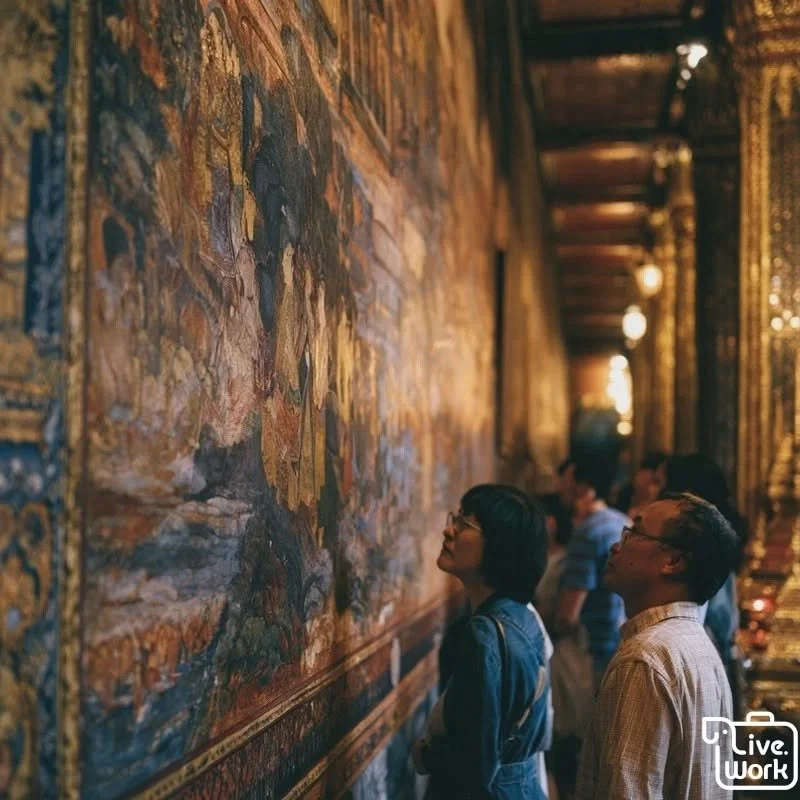
How to Read Thai Temple Murals: Visual Storybooks, Symbols, Characters, and Respectful Curiosity
Temple murals can feel overwhelming at first. You step into a hall, look up at the walls, and suddenly there are palaces, forests, monks, demons, animals, celestial beings, crowds, battles, processions, rivers, boats, markets, and golden figures all sharing the same painted space. The wall may not look like a modern comic strip with neat frames and captions. It may feel crowded, layered, and mysterious. But once you slow down and understand what to look for, the murals begin to open. They become visual storybooks.
Thai temple murals are not only decoration. They are painted teachings, memory devices, moral landscapes, and storytelling worlds. Many murals show Buddhist stories, episodes from the life of the Buddha, Jataka tales about the Buddha’s previous lives, heavenly and earthly realms, scenes of temptation and wisdom, or local versions of famous narratives. At the same time, they often include everyday details: markets, houses, boats, animals, servants, musicians, villagers, clothing, tools, food, and humor. This is why they are so rewarding. They can speak about religion, morality, society, beauty, and daily life all at once.
You do not need to be an art historian to enjoy them. The most important skill is attention. Walk slowly. Look for movement. Notice repeated figures. Compare large and small characters. Watch how buildings mark different worlds. Follow gestures, eyes, weapons, offerings, animals, and pathways. The walls begin to make sense when you stop trying to understand everything immediately and start reading them patiently.
Start by Taking a Slow Lap
The best way to begin is not to stand in one place and expect the whole wall to explain itself. Start with a slow lap around the interior, if the space allows it. Let your eyes adjust to the light. Notice where the largest figures are, where the busiest scenes appear, where the Buddha image or main altar is placed, and how the painted walls relate to the sacred space of the room.
Temple murals are often designed to be experienced in relation to worship. The main Buddha image, the direction of the altar, the entrance, the ceiling, and the surrounding walls can all affect how the paintings feel. Some scenes may be placed behind the main image, above doorways, near windows, or high on the walls. Others may wrap around the room in bands or clusters.
Do not try to decode every scene on the first lap. Instead, gather impressions. Where does the story seem calm? Where does it become dramatic? Where are the crowds? Where are the heavenly figures? Where are the demons or guardians? Which figures appear again and again? Which parts are painted with gold or extra detail? This first slow lap gives you a map before you begin reading.
Look for the Direction of the Story
Many murals are arranged in panels, bands, registers, or continuous scenes. Sometimes the story moves clearly from one section to the next. In other cases, multiple moments appear in the same painted field, and the viewer has to follow clues. The easiest clue is movement.
Look at the direction figures are facing. Are they walking toward a palace, forest, boat, mountain, or seated teacher? Are animals moving in one direction? Are soldiers, servants, or villagers forming a procession? Are hands pointing toward something important? Do repeated figures show the same character at different moments in the story?
In some murals, one character may appear more than once on the same wall. This does not mean the painting is confused. It often means the wall is showing different moments from the same narrative in one continuous visual space. A crowned hero might appear first in a palace, later in a forest, and later again in a moment of sacrifice or triumph. The wall is not always trying to freeze one second in time. It may be showing a sequence.
Reading murals is therefore more like following a path than looking at a single picture. Let the painted bodies guide you. If figures are moving, follow them. If they are looking or pointing, look where they look. If a road, river, stairway, bridge, or procession appears, treat it as a visual sentence leading you through the story.
Repeating Characters: The Key to Following the Plot
Once you begin noticing repeated characters, temple murals become much easier to read. A crowned prince, a graceful princess, a wise monk, a hermit, a demon, a guardian, a king, a queen, or a celestial being may reappear across different sections. Their clothing, crown, posture, skin color, facial expression, or position can help you recognize them.
Crowned figures often signal royalty, leadership, or heroic status. A wise monk or hermit may suggest teaching, renunciation, meditation, or moral guidance. Protective guardians often stand at thresholds, palace gates, heavenly entrances, or important boundaries. Demons and mischievous figures often signal conflict, temptation, danger, or a turning point in the story.
Do not assume that every frightening figure is simply “evil” in a simple way. In Buddhist narrative art, demons, tempters, giants, and supernatural beings often have symbolic functions. They may represent obstacles, desire, fear, pride, anger, illusion, or forces that test virtue. Their exaggerated faces, weapons, size, or colors help make inner moral struggles visible.
The more you look, the more the cast of characters begins to feel familiar. A mural that first seemed crowded becomes a story with recurring roles.
Symbols That Help You Read the Wall
Symbols are like signposts. They help you understand what kind of moment you are seeing. A halo or glowing aura often suggests holiness, spiritual power, or a figure of special importance. A lotus motif can point toward purity, spiritual growth, or sacred presence. Grand architecture may signal a palace, royal court, temple, heavenly realm, or important city. Forest scenes may suggest exile, meditation, testing, or retreat from worldly life.
Clouds, floating figures, and elaborate celestial architecture may indicate heavenly realms. Darker, busier, or more chaotic scenes may suggest danger, conflict, temptation, or moral disorder. Animals can be part of the story, but they can also carry symbolic meaning depending on the narrative. Boats, rivers, roads, gates, and bridges often mark transitions from one stage of the story to another.
You do not have to know every symbol perfectly. Even without expert knowledge, symbols help you ask better questions. Why is this figure larger? Why is this person glowing? Why is the lotus repeated here? Why is the palace so detailed? Why are demons placed near the edge of the scene? Why are ordinary people crowded below while sacred figures appear above?
A mural rewards these questions. The answer may not always be immediate, but the act of noticing brings the painting to life.
Common Visual Clues in Temple Murals
| Visual Clue | What It May Suggest | How to Look More Closely |
|---|---|---|
| Halo or Radiant Aura | Holiness, spiritual importance, wisdom, or a figure who should be read as central to the moral meaning of the scene. | Notice whether the glowing figure is teaching, meditating, blessing, resisting temptation, or placed above other characters. |
| Lotus Motifs | Purity, spiritual awakening, sacred presence, or the idea of rising above worldly confusion. | Look for lotus forms near seated figures, thrones, offerings, ponds, borders, or sacred architectural details. |
| Grand Architecture | A palace, temple, royal court, heavenly realm, or important city where power, status, or sacred order is being shown. | Compare the size, decoration, and height of buildings to simpler houses, forests, or market scenes nearby. |
| Large Figures | Importance, spiritual authority, royal status, moral focus, or narrative priority rather than realistic physical size. | Ask why the painter wanted this figure to dominate the scene and how smaller figures relate to them. |
| Figures Placed Higher | Spiritual elevation, heaven, moral superiority, royal position, or a more important narrative level. | Look at whether lower areas show ordinary people, conflict, crowds, or worldly activity beneath the main scene. |
| Guardians at Entrances | Protection, boundary, transition, or the separation between ordinary space and sacred or royal space. | Notice whether they stand at gates, palace doors, temple thresholds, stairways, or heavenly entrances. |
| Demons or Mischievous Figures | Conflict, temptation, danger, disruption, or a moral test within the story. | Look at who they face, what they hold, and whether their presence changes the mood of the scene. |
Scale Matters: Bigger Often Means More Important
In many temple murals, scale is not realistic in the modern photographic sense. A spiritually important figure may be painted much larger than surrounding people. A king, hero, monk, Buddha, celestial being, or central character may dominate the composition even if the scene includes many other figures.
This kind of scale tells you where to look. The painter is guiding your attention. A large figure may represent moral importance, royal power, spiritual authority, or narrative focus. Smaller figures may show servants, villagers, soldiers, witnesses, animals, or ordinary people affected by the central action.
Height matters too. Important figures may appear higher on the wall, seated on thrones, placed inside elevated architecture, or positioned above crowds. This does not always mean they are physically floating. It can mean they occupy a higher moral, spiritual, or social level in the story.
Crowded lower areas are often fascinating. They may show everyday life, moral choices, humor, work, gossip, fear, desire, greed, devotion, or social disorder. Do not ignore them just because the main sacred figure is larger. The small people often make the story feel human.
Everyday Life in the Background
One of the great pleasures of temple murals is discovering the ordinary details. While the main story may be religious or heroic, the background can contain lively scenes of daily life. You might see vendors, musicians, boats, animals, workers, houses, children, soldiers, travelers, servants, markets, kitchens, gardens, or people reacting dramatically to events.
These details are not meaningless decoration. They help place sacred stories inside a world viewers could recognize. They also show how morality plays out in daily life, not only in grand moments. A busy crowd may show generosity, selfishness, gossip, loyalty, fear, confusion, or devotion. A market scene may reveal humor and social observation. A boat or house may show local architecture and historical memory.
This is where slow looking becomes especially rewarding. After you identify the main figures, let your eyes wander into the edges. Look at faces, gestures, animals, food, fabrics, tools, and body language. Temple murals often contain small surprises that are easy to miss on a quick visit.
Palaces, Forests, Heavens, and Human Worlds
Temple murals often shift between different kinds of spaces. A palace may represent power, family, duty, or worldly responsibility. A forest may represent exile, renunciation, danger, meditation, or testing. A heavenly realm may represent reward, purity, spiritual aspiration, or divine presence. A village or market may represent ordinary human life and moral choice.
Architecture is one of the easiest ways to track these changes. Palaces and heavenly structures are often more elaborate, symmetrical, and elevated. Forests may be dense, dark, or filled with animals and hermits. Everyday human spaces may include houses, shops, boats, pathways, and crowds.
Once you notice these settings, the story becomes clearer. A hero leaving a palace for a forest may signal sacrifice or transformation. A monk seated calmly in nature may suggest spiritual discipline. A demon entering a royal or sacred space may signal disruption. A crowd gathered below a palace may show public consequence or social reaction.
The walls become easier to read when you ask not only “Who is this?” but also “Where are we now?”
Reading a Mural Like a Story
| Step | What to Notice | Why It Helps |
|---|---|---|
| Take a Slow Lap | Look for the main altar, largest figures, repeated scenes, architectural zones, and the overall direction of movement. | This gives you a basic map before you try to understand individual details. |
| Find the Main Figures | Look for crowned heroes, monks, Buddha images, guardians, demons, kings, queens, or figures with halos. | Recognizing the main characters makes the wall feel less crowded and more narrative. |
| Follow Movement | Watch the direction of walking figures, processions, roads, rivers, boats, gestures, and gazes. | Movement often reveals how one scene leads into the next, even when the mural is not divided into neat boxes. |
| Compare Scale and Height | Notice which figures are larger, higher, seated on thrones, placed above crowds, or surrounded by decoration. | Scale and placement usually show importance, spiritual status, royal authority, or moral focus. |
| Read the Setting | Identify palaces, forests, heavens, villages, markets, temples, rivers, and roads. | Setting helps you understand whether the story is about worldly life, spiritual testing, royal duty, conflict, or sacred teaching. |
| Look at the Edges | Observe small figures, animals, servants, vendors, musicians, ordinary crowds, and humorous or dramatic details. | The edges often reveal everyday life and moral choices that make the larger story feel human. |
Guardians and Demons: Reading Conflict and Protection
Guardians and demons are some of the most visually striking figures in temple murals. Guardians may appear strong, symmetrical, richly dressed, or placed near entrances and important spaces. They are not always part of the main story in a simple way. Sometimes they mark boundaries between worlds: outside and inside, ordinary and sacred, earthly and heavenly, safe and dangerous.
Demons, giants, and mischievous supernatural figures often add energy and conflict. Their exaggerated faces, teeth, colors, weapons, postures, or expressions make them easy to identify. They may represent literal characters in a story, but they may also help make invisible forces visible: anger, greed, jealousy, fear, desire, temptation, or chaos.
When you see these figures, ask what they are doing. Are they attacking? Guarding? Tempting? Blocking a path? Carrying someone away? Bowing? Listening? Standing at a threshold? Their action matters more than their appearance alone.
A demon in a mural is not just there to look dramatic. It usually signals that the story has reached a test.
Halos, Lotuses, and Sacred Calm
Some parts of a mural feel visually quieter than others. A seated figure with a halo, a lotus throne, calm posture, and surrounding symmetry usually asks the viewer to slow down. The scene may show teaching, meditation, enlightenment, blessing, or moral resolution.
Lotus imagery is especially important because it connects beauty with spiritual meaning. A lotus grows from muddy water but rises clean above the surface, which makes it a powerful symbol for purity and awakening. When lotus motifs appear near sacred figures, thrones, ponds, or decorative borders, they help mark the scene as spiritually charged.
Halos and radiant areas work similarly. They draw attention and create a visual field of importance. If a mural feels crowded, look for brightness, gold, halos, or repeated sacred motifs. They can help you find the center of meaning.
Crowds and Moral Choices
Crowds in temple murals are worth careful attention. They may look chaotic at first, but they often show the human world responding to the main event. Some people may show devotion. Others may show fear, confusion, greed, desire, anger, or curiosity. Their gestures tell you how the story affects ordinary life.
Look at hands and faces. Are people bowing, pointing, running, fighting, gossiping, offering gifts, carrying goods, or looking upward? Are they calm or panicked? Are they dressed as nobles, monks, villagers, soldiers, merchants, or servants? These details help you understand the moral atmosphere of the scene.
A crowd can also make a sacred story feel close to everyday experience. It reminds the viewer that moral choices are not only made by kings, monks, and heroes. Ordinary people are part of the story too.
Respectful Curiosity Inside the Temple
Looking closely at murals should always be done respectfully. These paintings are often inside active religious spaces, not only museums. People may be praying, meditating, making offerings, listening to chanting, or simply sitting quietly. Your curiosity should fit the atmosphere of the temple.
Dress respectfully, speak softly, and avoid blocking worshippers. Do not point aggressively at sacred images during ceremonies. Do not use flash photography unless it is clearly allowed, because flash can disturb people and may harm delicate surfaces over time. Never touch murals. Even clean hands can leave oils, moisture, or damage on old painted surfaces.
If photography is prohibited, respect the rule. If photography is allowed, take photos quietly and step aside. Do not turn the temple interior into a staged photo set. The best way to read murals is to be present, not disruptive.
Respect also means accepting that you may not understand everything. Some scenes may require knowledge of Buddhist texts, local legends, regional styles, or restoration history. That is fine. You can still notice beauty, structure, emotion, and meaning with care.
How to Spend Twenty Minutes with a Mural
If you only have a short visit, spend twenty minutes with one wall rather than rushing through every painted surface. Begin by standing back and identifying the biggest figures and main settings. Then move closer, without touching, and look for repeating characters. Follow the direction of movement. Notice symbols such as halos, lotuses, palaces, forests, guardians, and demons.
After that, choose one small section and stay with it. Look at the faces. Look at the hands. Look at the animals. Look at the architecture. Try to understand what is happening emotionally, even if you do not know the exact story. Is the scene joyful, tense, sacred, chaotic, generous, violent, peaceful, or comic? The emotional tone often comes through before the full narrative does.
Finally, step back again. The wall will look different. What first seemed like a mass of color may now have characters, direction, symbols, and rhythm. That is the moment when the mural begins to speak.
What Beginners Often Miss
Beginners often look only for the most beautiful or central figure. That is natural, but it means they miss much of the story. Temple murals often hide their richness in smaller scenes: servants carrying objects, animals reacting, villagers arguing, boats crossing rivers, musicians playing, demons watching from the edge, or crowds making moral choices below the main action.
Another thing beginners miss is repetition. If the same figure appears in different places, the wall may be showing a sequence of events. Instead of asking why the painter repeated the character, follow the repetition as a story path.
Beginners also sometimes expect everything to be realistic in perspective or scale. Thai temple murals may organize space according to importance, narrative, and symbolic meaning rather than strict realism. A palace may be shown from an impossible angle so the viewer can see inside. A figure may be large because they are morally central. Several events may appear together because the wall is telling a long story, not capturing one camera-like moment.
Once you let go of modern expectations, the murals become much easier to enjoy.
Conclusion
Thai temple murals are visual storybooks filled with movement, symbols, repeated characters, sacred spaces, everyday life, and moral meaning. To read them, begin with a slow lap, follow the direction of figures and processions, look for recurring heroes, monks, guardians, demons, and royal characters, and use visual clues such as halos, lotus motifs, grand architecture, scale, and placement to understand what matters most. Do not ignore the crowded edges, because ordinary people, animals, markets, boats, and humorous details often make the story feel alive. No expert knowledge is required. With attention, patience, and respect, the walls begin to speak, and a temple visit becomes much more than a quick look at beautiful paintings.