How to Join a Local Thai Event Respectfully: Etiquette for Ceremonies, Community Gatherings, and Family Occasions
Joining a local event in Thailand can be one of the most meaningful ways to experience Thai culture. A temple ceremony, neighborhood festival, wedding, family meal, funeral, merit-making event, or village celebration offers a view of everyday life that is difficult to find at formal tourist attractions.
Visitors are rarely expected to understand every custom perfectly. What matters most is showing consideration, observing the people around you, and adjusting your behavior to the setting. Dressing modestly, greeting people politely, waiting for cues, and treating food, sacred objects, elders, and shared spaces with respect will usually make a positive impression.
Thai social etiquette often depends on context. A lively community festival may be relaxed and informal, while a religious ceremony or funeral requires quieter behavior. The safest approach is to notice how local participants are dressed, where they sit, when they remove their shoes, and when they begin eating or taking photographs.
Understanding the Type of Thai Event You Are Attending
Local Thai events range from casual gatherings to highly structured ceremonies. Before attending, it helps to know whether the occasion is religious, social, celebratory, or connected to mourning.
Temple events and merit-making ceremonies often involve monks, offerings, chanting, incense, and clearly defined seating arrangements. Weddings may combine formal rituals with a relaxed reception, while community festivals can include food stalls, music, performances, processions, and religious activities in the same area.
Funerals in Thailand may take place over several evenings and can include chanting, meals, and conversations among family members and guests. Although people may speak and socialize, the event still requires subdued clothing and respectful behavior.
A family meal or neighborhood celebration may feel informal, but elders and hosts are still treated with particular consideration. When uncertain, follow the tone established by the host rather than assuming that every Thai gathering follows the same rules.
Dress Modestly for Ceremonies and Religious Settings
Modest clothing is the most reliable choice for a local Thai event, particularly when a temple, monk, shrine, or formal ceremony is involved. Shoulders should generally be covered, and shorts, skirts, or dresses should reach close to the knees or below.
Clothing does not need to be elaborate. A clean shirt with sleeves, lightweight trousers, a long skirt, or a modest dress will suit many occasions. Breathable fabrics are useful because ceremonies may take place in warm buildings, outdoor courtyards, or spaces without strong air-conditioning.
Very revealing clothing, beachwear, transparent fabrics, and shirts with offensive images or language should be avoided. Even when an event is held near a beach or tourist area, the ceremonial section may still require a more conservative appearance.
Shoes that can be removed easily are practical. Visitors may need to take them off before entering a temple building, shrine room, private home, or raised indoor area. Socks should also be clean because they may remain visible after shoes are removed.
For funerals, dark or subdued clothing is normally appropriate. Bright party clothes and heavily festive accessories may seem insensitive. Weddings are more variable, and the host may specify a color theme or dress code, so checking in advance is useful.
Remove Your Shoes When the Setting Requires It
Removing shoes is common before entering Thai homes and many religious or traditional spaces. A row of shoes near an entrance is usually a clear sign that footwear should be left outside.
Temple complexes often allow shoes in outdoor areas but require them to be removed before entering specific halls or buildings. Look for signs, shoe racks, or the behavior of other visitors.
Do not step directly on other people’s shoes or place your footwear on top of theirs. Leave shoes neatly to the side without blocking the entrance.
In private homes, wait briefly at the doorway if you are unsure. The host may tell you to keep your shoes on, but it is more polite to be prepared to remove them than to walk inside automatically.
Greeting People with a Wai
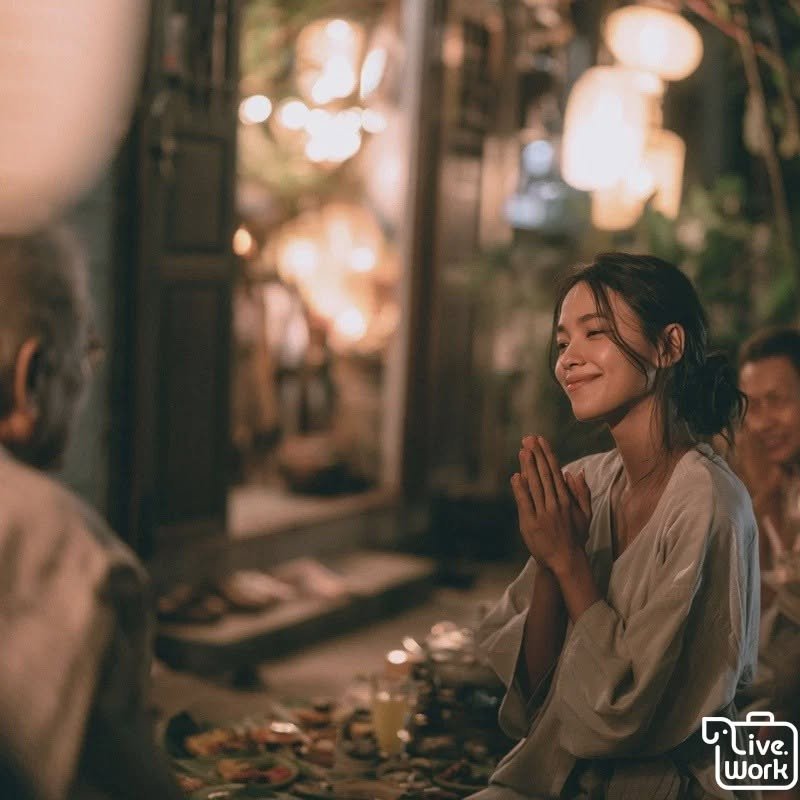
The traditional Thai greeting is the wai, written ไหว้ and pronounced approximately “wai.” It is made by placing the palms together in front of the chest or face and slightly lowering the head.
The height of the hands and depth of the bow traditionally reflect age, status, and the level of respect being shown. Visitors do not need to reproduce these distinctions perfectly. A simple wai with the hands around chest level, accompanied by a small nod and a warm smile, is usually sufficient.
Elders, hosts, and people leading a ceremony may be greeted with particular respect. When someone offers a wai, returning it is generally polite, although service staff and children do not always expect guests to initiate or return the gesture in exactly the same way as Thai adults.
Avoid turning the wai into an exaggerated performance. It should be calm, natural, and brief. A smile and a polite verbal greeting are often just as important as precise hand placement.
The common Thai greeting is สวัสดี, pronounced approximately “sa-wat-dee.” Male speakers usually add ครับ, pronounced “khrap,” while female speakers usually add ค่ะ, pronounced “kha.” These polite particles soften speech and show courtesy.
Show Respect to Elders and Hosts
Age and social roles often influence behavior at Thai gatherings. Elders may be invited to sit first, receive food first, or take a leading role in a ceremony.
When introduced to an older person, a polite wai, calm voice, and attentive manner are appropriate. Avoid interrupting or speaking too loudly over them.
Hosts may spend considerable time arranging food, seating, transport, or introductions for guests. A brief expression of thanks is appreciated, even when the gathering feels informal.
The Thai concept of เกรงใจ, pronounced approximately “kreng jai,” is helpful for understanding local social behavior. It describes a sense of consideration and reluctance to inconvenience others. Guests can show kreng jai by avoiding unnecessary demands, accepting reasonable arrangements graciously, and noticing when a host is making an effort on their behalf.
This does not mean remaining silent when there is a genuine problem. Dietary restrictions, allergies, transport difficulties, or health concerns should be communicated clearly and politely.
Keep Your Voice and Body Language Calm
Thai social communication often values calmness, especially during formal or religious moments. Loud voices, visible irritation, aggressive gestures, and public arguments can make others uncomfortable.
At festivals and parties, conversation and music may naturally become lively. During chanting, speeches, blessings, prayers, or moments of remembrance, follow the quieter tone of the group.
Pointing directly at people with one finger can appear abrupt. When indicating a person, object, or direction, a gentle open-hand gesture is often more courteous.
Avoid standing over seated elders or ceremony participants for longer than necessary. If people are sitting on the floor, move carefully and avoid stepping across food, offerings, or personal belongings.
Physical affection between couples is best kept moderate at traditional or religious events. Friendly behavior is welcome, but highly intimate displays may feel unsuitable in a formal community setting.
Be Aware of the Head and Feet
Traditional Thai etiquette treats the head as the highest and most respected part of the body, while the feet are considered the lowest. These ideas influence several everyday customs.
Avoid touching another person’s head, including a child’s, unless you know that person well and are certain the gesture is welcome. A playful pat that seems harmless elsewhere may be uncomfortable in Thailand.
The feet should not be used to point at people, food, images of the Buddha, monks, shrines, or ceremonial objects. When sitting on the floor, try to keep your feet tucked to the side or pointed away from the main ceremonial area.
Stepping over people, food, offerings, books, or sacred items should also be avoided. Walk around them instead.
Sitting cross-legged may be acceptable in informal situations, but during temple ceremonies many people kneel or sit with their legs folded to one side. Visitors with limited mobility are not expected to remain in a painful position. Sitting respectfully on a chair or adjusting posture carefully is better than risking injury.
Follow Local Cues During Temple Ceremonies
Temple events often include chanting, offerings, blessings, candles, incense, or food presented to monks. Visitors should watch before participating rather than copying individual actions without understanding the sequence.
Monks occupy a respected position in Thai Buddhist settings. Their seating areas, food, and ceremonial items may be arranged separately. Do not sit on a platform reserved for monks or place personal belongings on their seats.
Women should avoid directly handing objects to a monk. An item may be placed on a cloth, tray, or surface, or passed through a male intermediary, depending on the circumstances. The monk or local host will normally indicate the appropriate method.
When sitting near monks or Buddha images, avoid pointing the soles of the feet toward them. Move quietly during chanting and avoid walking directly in front of participants unless necessary.
Visitors are not required to perform prayers or Buddhist gestures that conflict with their beliefs. Remaining quiet, standing or sitting respectfully, and following practical instructions is sufficient.
Accepting Food and Drinks Politely
Food is central to many Thai social events. Guests may be offered snacks, fruit, drinks, or a full meal soon after arriving, even when the event is not primarily about dining.
When someone hands you food or a drink, receiving it with the right hand is courteous. Using both hands can show additional respect, especially when receiving something from an elder or formal host. This is a polite gesture rather than an inflexible rule.
Trying a small amount is often appreciated because food may have been prepared specifically for guests. However, visitors should not eat something that creates a medical, religious, or dietary problem. A warm thank-you and a simple explanation are better than forcing yourself to eat.
The Thai phrase ขอบคุณ, pronounced approximately “khop khun,” means thank you. Male speakers usually say ขอบคุณครับ, or “khop khun khrap,” while female speakers generally say ขอบคุณค่ะ, or “khop khun kha.”
Complimenting the food is also welcome. อร่อย, pronounced approximately “a-roi,” means delicious. Saying อร่อยมาก, or “a-roi mak,” means very delicious.
Wait for Cues Before Beginning to Eat
At a casual market-style event, people may begin eating as soon as they receive their food. At a family gathering or formal meal, it is better to wait briefly and observe the host, elders, or other guests.
Shared dishes are common in Thailand. Several plates may be placed in the center of the table, with each person taking small portions to eat with rice. Do not move a shared dish permanently in front of yourself or take an unusually large amount before others have been served.
Serving spoons should be used when provided. Avoid using your personal spoon to take food directly from a communal dish.
Thai meals are often eaten with a spoon and fork. The fork is generally used to push food onto the spoon, which is then brought to the mouth. Chopsticks are more commonly used for certain noodle dishes and foods influenced by Chinese culinary traditions.
Rice is treated as an important part of the meal, so taking only the amount you expect to eat helps avoid waste. Additional food can usually be taken later.
Handling Spicy or Unfamiliar Food
Food at a local event may be prepared according to local preferences rather than adjusted for international visitors. Chili, fish sauce, shrimp paste, fermented ingredients, herbs, offal, or unfamiliar textures may appear in dishes.
It is acceptable to ask what something is before eating it. A curious and respectful question is preferable to making a negative comment after tasting the dish.
If a dish is too spicy, avoid reacting dramatically. Drink water, eat rice, and move on to another dish. Laughing gently about your own spice tolerance is usually better received than criticizing the food.
People with allergies should communicate them before the meal whenever possible. Thai cooking often uses shared woks, grills, utensils, sauces, and preparation surfaces, so cross-contact can occur even when an ingredient is not visibly present.
Declining food is sometimes necessary. A polite smile, a thank-you, and a brief explanation usually prevent misunderstanding.
Photography and Social Media Etiquette
Local Thai events can be visually fascinating, but not every moment should automatically be photographed. Religious rituals, funerals, private blessings, and family interactions may require particular sensitivity.
Observe whether local guests are taking photographs. If cameras are common and no restrictions are posted, general photography may be acceptable. When one person is the main subject, asking permission is considerate.
Avoid stepping into ceremonial areas, blocking processions, standing between monks and participants, or using flash during quiet rituals. A photograph is not worth interrupting the event.
Children should not be photographed closely without permission from a parent or responsible adult. The same applies to elderly people, people praying, or anyone experiencing an emotional moment.
Before posting images publicly, consider whether the event was genuinely open to the public. An invitation to attend a family or community gathering does not always imply permission to publish identifiable photographs online.
Bringing a Gift to a Thai Gathering
A small gift may be appropriate when invited to a private home, family celebration, or special occasion. Fruit, sweets, flowers, or another modest item can be a thoughtful choice.
The gift does not need to be expensive. The gesture and presentation are usually more important than the price.
Some flowers and colors have specific associations, especially at weddings and funerals, so asking a Thai friend or host for guidance can prevent an unsuitable choice.
Gifts may not be opened immediately. This should not be interpreted as a lack of appreciation. The host may prefer to open them later or avoid creating comparisons between gifts.
At temple or merit-making events, donations may be collected in a designated place. Follow the method used by local guests and avoid displaying money unnecessarily.
Participating Without Taking Over
Local events sometimes invite visitors to dance, help prepare food, join a procession, light incense, or take part in a game. Participation can be a friendly way to connect, but it should remain responsive rather than performative.
Wait to be invited into ceremonial or private areas. Do not assume that enthusiasm automatically grants access.
When invited to try an activity, follow instructions and keep the mood relaxed. Making mistakes is rarely a serious problem when the visitor is attentive and good-humored.
Avoid turning the gathering into content created mainly for an audience elsewhere. Constant filming, repeated poses, loud commentary, or directing local participants can change the atmosphere and make the event feel less comfortable.
The goal is to share the occasion, not to become its center.
Etiquette at Thai Weddings and Celebrations
Thai weddings can include Buddhist ceremonies, family rituals, traditional processions, formal photographs, meals, speeches, and evening entertainment. Some elements may be private, while others involve a large group of guests.
Arrive at the requested time, especially when invited to a morning ceremony. Formal rituals may begin earlier than the later meal or reception.
A monetary gift in an envelope is common at many weddings, but expectations vary according to the relationship, venue, and event. When uncertain, ask the person who invited you rather than relying on a universal amount.
At birthday parties, company celebrations, and community festivals, the atmosphere may be more casual. Even so, allow elders, hosts, and honored guests to lead formal moments such as speeches, blessings, or group photographs.
Respectful Behavior at Thai Funerals
Thai funerals can differ according to religion, region, family tradition, and personal wishes. Buddhist funerals often include evening chanting over several days, followed by cremation or another final ceremony.
Guests should wear black, white, dark blue, grey, or another subdued color unless the family provides different instructions. Clothing should be modest and neat.
Conversation is not always completely silent. Guests may eat, speak with friends, and support the family through their presence. The overall tone should nevertheless remain calm and respectful.
Follow others when presenting flowers, lighting incense, approaching the coffin, or greeting the family. Photography should be avoided unless it is clearly accepted and appropriate.
A simple expression of sympathy is enough. Visitors are not expected to deliver a long speech or understand every ritual.
Common Mistakes to Avoid
One common mistake is assuming that friendliness removes the need for formality. Thai hosts may be warm and relaxed while still expecting respectful dress and behavior during ceremonial moments.
Another mistake is copying a wai excessively or greeting every person with the same deep bow. A natural greeting is better than an exaggerated attempt to demonstrate cultural knowledge.
Visitors may also sit with their feet directed toward a shrine, step over food, or enter a building without noticing the shoes outside. Watching the people around you prevents most of these errors.
Complaining loudly, arguing about arrangements, or demanding special treatment can create discomfort. Calmly explaining a genuine need is more effective.
The most important mistake to avoid is treating the event as a performance staged for tourists. Local gatherings belong first to the families, communities, and participants who created them.
Conclusion
Joining a local Thai event does not require perfect knowledge of every custom. Respect is shown through practical details: dressing modestly, removing shoes when appropriate, greeting people politely, lowering your voice during formal moments, and following the lead of hosts and elders.
Food should be accepted graciously when possible, shared dishes should be handled considerately, and religious spaces should be approached with particular care. Keeping feet away from people and sacred objects, avoiding unnecessary contact with heads, and asking before taking close photographs will prevent many common misunderstandings.
Most Thai hosts understand that international visitors may be unfamiliar with local etiquette. Genuine attention, patience, and a willingness to observe matter more than flawless execution. When uncertain, pause and watch what local participants do. Considerate behavior is usually recognized even when the visitor does not know every rule.