Chiang Mai Craft Villages: How to Visit Woodcarvers, Ceramic Studios, and Weaving Communities Respectfully
Chiang Mai’s craft villages are most rewarding when visitors look beyond the finished products and pay attention to the work behind them. A carved panel may represent days of careful chiselling, a celadon bowl may pass through several stages of shaping, glazing, and firing, and a woven textile may require hundreds of repeated movements before its pattern becomes visible.
The region’s craft traditions are closely connected to Lanna culture, the historical culture of northern Thailand. Woodcarving, pottery, weaving, silverwork, lacquerware, umbrella making, basketry, and other skills have developed through families, workshops, temples, and village communities. Some artisans continue established designs, while others combine inherited techniques with modern forms and materials.
Visitors can explore woodcarving at Baan Tawai in Hang Dong, ceramics and celadon at studios east and north-east of Chiang Mai, traditional pottery at Ban Muang Kung, and handwoven cotton in communities such as Ban Rai Phai Ngam. These places vary considerably: some are active villages, some are workshop clusters, and others are commercial centres where production and retail operate side by side.
The best approach is to slow down. Greet the maker, wait to be invited into a working area, ask before photographing, and buy thoughtfully rather than treating the visit as a fast shopping stop. Respectful interest often leads to a much richer understanding of the craft.
Why Chiang Mai Became an Important Craft Centre
Chiang Mai has long been a cultural and commercial centre of northern Thailand. Its position connected lowland communities with mountain areas, neighbouring regions, and older trade routes. Local makers worked with materials such as wood, clay, cotton, bamboo, lacquer, metals, natural dyes, and plant fibres.
Craft knowledge was commonly passed through families or learned within communities. A child might begin by preparing materials, watching an older relative, or repeating a simple part of the process before progressing to more difficult work. The finished object was only one part of the tradition; knowledge of tools, materials, motifs, timing, and appropriate use was equally important.
Today, Chiang Mai’s craft landscape includes both traditional village production and contemporary design studios. Some workshops make temple decorations or household objects using familiar Lanna patterns. Others reinterpret older methods in modern tableware, clothing, furniture, jewellery, and interior design. Chiang Mai’s current creative scene continues to bring established artisans and younger designers into the same wider ecosystem.
This mixture makes the region especially interesting. Visitors can see heritage skills without assuming that craft must remain frozen in the past.
Comparing Chiang Mai’s Main Craft Experiences
Different craft areas suit different interests. Some are easy to explore independently, while others are more meaningful with an appointment, guide, or pre-arranged workshop.
| Craft Area | Main Experience | What Visitors May See | Best Suited To |
|---|---|---|---|
| Baan Tawai | A large woodcarving and handicraft community with workshops, galleries, furniture makers, and shops. | Carving, sanding, finishing, furniture production, decorative panels, sculptures, and restored pieces. | Visitors interested in woodwork, home decoration, furniture, and comparing many makers in one area. |
| Celadon studios around Chiang Mai | Workshop and showroom visits focused on northern Thai ceramic traditions and distinctive glazed ware. | Clay preparation, shaping, carving, painting, glazing, firing explanations, and finished tableware. | Ceramics enthusiasts, design lovers, and visitors seeking practical handmade objects. |
| Ban Muang Kung | A traditional pottery village where earthenware remains part of the local streetscape and household economy. | Hand-shaped pottery, drying vessels, kilns, household containers, decorative figures, and village architecture. | Travelers who prefer a small community atmosphere over a large retail centre. |
| Weaving communities | Visits centred on handwoven cotton, local patterns, looms, dyes, clothing, and textile heritage. | Thread preparation, loom setup, pattern development, weaving, finished textiles, and traditional tools. | Textile enthusiasts and visitors interested in the relationship between craft, identity, and daily life. |
Visitors should avoid trying to cover every craft tradition in one hurried day. Baan Tawai and Ban Muang Kung can form a logical southern route, while celadon studios and craft destinations around San Kamphaeng or Doi Saket are better approached as a separate eastern excursion. More distant weaving communities may deserve their own half-day or full-day visit.
Baan Tawai: Chiang Mai’s Best-Known Woodcarving Village
Baan Tawai, or บ้านถวาย, is located in Hang Dong District south of Chiang Mai. It is widely associated with woodcarving, furniture, decorative objects, antiques-style reproductions, and northern Thai handicrafts. The area contains individual workshops as well as larger commercial zones, making it one of the easiest places to compare different approaches to woodwork.
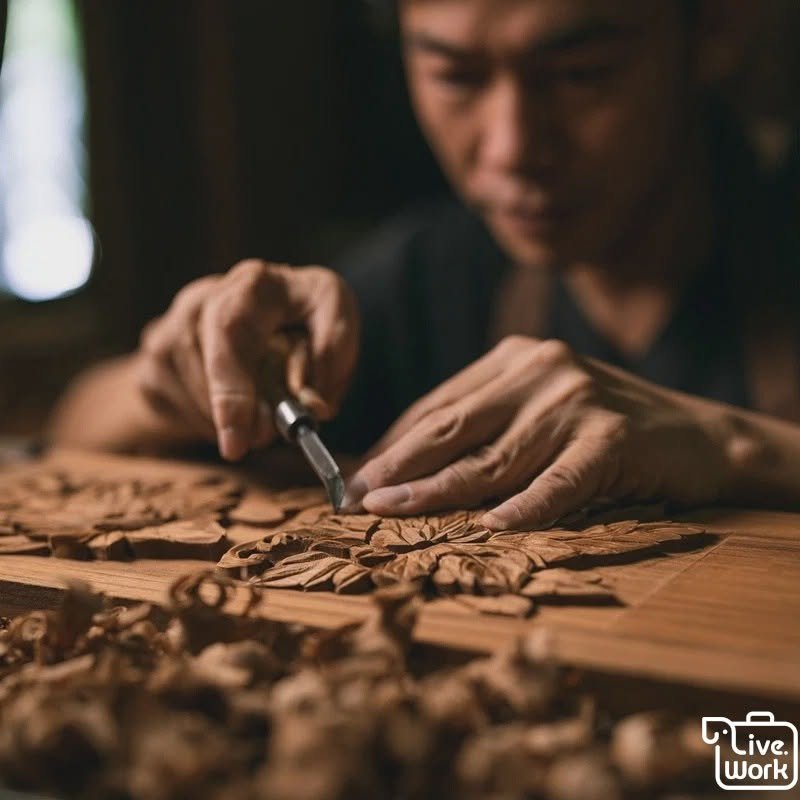
The most interesting moments often take place away from polished showrooms. In an active workshop, visitors may see a design drawn onto wood, rough shapes removed with larger tools, small details cut with narrow chisels, and the surface gradually sanded and finished.
A highly detailed carving may involve several workers with different skills. One person may prepare the basic form, another may carve decorative details, and someone else may handle sanding, staining, painting, or finishing. Asking who made a piece can reveal whether it came from the visible workshop, another local household, or a separate production centre.
Not every wooden object is made from teak. Chiang Mai artisans work with several types of wood depending on cost, availability, durability, weight, and the intended design. Buyers should ask which wood was used rather than relying on appearance or a general description.
Wood origin also matters. Responsible buyers can ask whether the material comes from a legal and traceable source, particularly when considering large furniture, expensive carvings, or items that will be shipped internationally. A receipt containing the material description may be helpful when arranging transport or checking current import requirements at home.
How to Watch Woodcarvers Without Interrupting Their Work
A carving workshop contains sharp tools, dust, unfinished surfaces, power equipment, and objects that may be unstable. Visitors should remain in the area indicated by the maker rather than moving behind a workbench or stepping over tools.
Begin with a greeting and pause at the entrance. A simple สวัสดีครับ, pronounced approximately “sa-wat-dee khrap,” for a male speaker, or สวัสดีค่ะ, “sa-wat-dee kha,” for a female speaker, is sufficient.
Watch quietly before asking questions. A craftsperson making a delicate cut may need to complete it before looking up. Speaking loudly or repeatedly requesting posed demonstrations can interrupt concentration and turn real work into a performance.
If a demonstration is offered, ask whether there is a fee. Some workshops include demonstrations as part of the visit, while others depend on workshop charges, product sales, or voluntary contributions. A modest tip may be appropriate after a personal demonstration when it is clearly welcome, but buying directly from the maker often provides more meaningful support.
Celadon Ceramics: Clay, Glaze, Heat, and Controlled Imperfection
Celadon is a ceramic tradition known for translucent glazes that commonly appear in pale green, blue-green, grey-green, olive, or related tones. The surface may show fine crackled lines created by the relationship between the ceramic body and glaze during cooling.
Chiang Mai has several celadon studios, factories, showrooms, and smaller ceramic workshops. Some allow visitors to observe parts of the process, while others offer painting, shaping, or decorating activities. Official Thai tourism material identifies celadon as one of Chiang Mai’s characteristic craft products and highlights established ceramic workshops in the region.
The finished glaze can make the process appear effortless, but ceramics require patience. Clay must be prepared, shaped, dried slowly, decorated or carved, fired, glazed, and fired again according to the studio’s method. A fault at one stage may only become visible after firing.
Visitors should understand that a functioning kiln schedule does not always match a tourism timetable. A studio may be shaping clay during one visit and glazing or unloading a kiln on another day. Seeing every production stage in a single hour is rarely realistic.
Small differences in colour, crackling, form, and brushwork are normal in handmade ceramics. These variations are not necessarily defects. They may be evidence that the object was individually shaped, glazed, or decorated rather than produced as an identical industrial set.
Traditional Pottery at Ban Muang Kung
Ban Muang Kung is a pottery community south of Chiang Mai where clay vessels have historically been produced for household, religious, and decorative use. Pottery remains visible in courtyards, along walls, and around village homes, giving the area a different character from a purpose-built commercial craft centre.
The village is particularly interesting for visitors who want to understand craft as part of community life. Pottery may be produced near homes rather than inside a formal visitor facility, and the pace can depend on household responsibilities, agricultural work, weather, and current orders.
Traditional vessels often reveal the maker’s hands more clearly than highly finished showroom ceramics. Slight asymmetry, marks from shaping, and variations in firing give each object an individual character.
A village street is still a residential environment. Visitors should not walk into courtyards, touch drying pottery, or enter houses simply because work is visible from the road. A greeting and invitation should come before closer observation.
Weaving Communities and Story-Rich Textiles
Northern Thai textiles communicate far more than colour and pattern. Material, weave, border design, clothing form, and decorative details may relate to geography, community identity, family knowledge, ceremonial use, or personal creativity.
Ban Rai Phai Ngam in Chom Thong District is associated with handwoven cotton and the legacy of textile teacher Saeng-da Bansiddhi. The community includes weaving knowledge, traditional equipment, and textile collections that help explain how cloth moves from thread to finished form.
Watching a loom changes the way a visitor understands fabric. The weaver must control tension, count threads, coordinate hands and feet, and maintain the pattern over long periods. A mistake may require several rows to be undone.
Not every design should automatically be described as ancient or sacred. Some patterns are inherited, some are adapted, and others are newly designed. It is better to ask what a pattern means to that particular maker than to assign a general cultural story based only on appearance.
Visitors interested in buying textiles should ask whether the piece is handwoven, machine woven, hand-dyed, naturally dyed, embroidered, or assembled from several methods. These distinctions help explain differences in price and production time.
Asking Permission Before Taking Photographs
Photography should never be assumed simply because a workshop is open to visitors. Artisans may decline because they are working on a private commission, protecting an original design, avoiding distraction, or simply preferring not to be photographed.
Ask before photographing the maker, tools, production stages, patterns, or the inside of a workshop. Pointing to the camera and politely asking is often enough when language is limited.
The Thai phrase ถ่ายรูปได้ไหม, pronounced approximately “thai rup dai mai,” means “May I take a photograph?” Adding khrap or kha makes it more polite.
Permission to photograph a finished product does not automatically include permission to record the entire production process. Video can feel more intrusive because it captures movements, conversations, tools, and methods in greater detail.
When the answer is no, put the camera away without showing disappointment. Respecting the refusal creates a better interaction than trying to obtain the same image secretly from farther away.
Paying Fairly and Bargaining with Respect
Craft pricing reflects more than raw materials. It may include years of training, failed pieces, design work, tool maintenance, workshop rent, fuel for firing, finishing, packaging, and time spent explaining the process to visitors.
When a price is clearly posted, paying that price is generally the most respectful approach. Aggressive bargaining over a handmade object can reduce the value of hours or days of work to a brief contest over a small amount of money.
A polite question about price is entirely appropriate. ราคาเท่าไหร่, pronounced approximately “raa-khaa thao-rai,” means “How much is it?”
For several items or a large purchase, the maker may voluntarily offer a package price. Visitors can also politely ask whether there is a combined price, but should accept the answer without pressure.
The lowest-priced object is not necessarily the best value. A slightly more expensive piece bought directly from its maker may provide clearer provenance, better quality, and more direct support than an apparently similar item from a general souvenir shop.
Joining a Short Craft Workshop
A hands-on workshop can create a deeper appreciation of the skill involved. Depending on the venue, visitors may paint a ceramic piece, try simple weaving, carve a small pattern, dye fabric, shape clay, or assemble a basic craft object.
Participants should not expect to master the technique in one session. The purpose is to understand tools, materials, and movements rather than produce work equal to that of an experienced artisan.
Workshop times, language support, minimum group sizes, and firing or collection arrangements can vary. A ceramic piece may need to dry and be fired after the visitor leaves, making immediate collection impossible. Booking directly with the workshop or through a trusted local organiser helps clarify what is included.
The workshop fee should be treated as payment for instruction and materials, not merely as the price of the final object. Even when the result is imperfect, the learning experience has value.
Planning a Craft-Focused Day from Chiang Mai
Craft villages are spread across the wider Chiang Mai area, so transport planning matters. A private driver or rental car is usually the most efficient option for visiting several locations, especially when carrying ceramics or large purchases.
Ride-hailing services may work for an outward journey, but return availability can be less predictable in smaller villages. Arranging a waiting driver or confirming pickup in advance provides greater certainty.
Scooters offer flexibility but should be used only by licensed and experienced riders wearing proper helmets. Heat, rain, traffic, uneven road surfaces, and the need to carry fragile purchases can make a car the more practical option.
Allow more time than a standard shopping visit. Conversations, demonstrations, workshop activities, lunch, and careful packing can easily extend the day. Two meaningful stops are often better than five rushed ones.
Operating hours and demonstrations may change according to orders, family commitments, festivals, or seasonal demand. Contacting a studio before making a special journey is sensible, particularly when the aim is to meet a specific maker.
Buying, Packing, and Transporting Handmade Crafts
Small textiles, baskets, and lightweight carvings are relatively easy to carry, but ceramics and large wooden objects require more planning.
Inspect ceramic pieces in good light and ask the seller to show any intentional crackling, handmade variation, or actual damage. Request secure wrapping and keep fragile pieces in hand luggage when airline rules allow.
For textiles, ask about washing, colour transfer, and exposure to sunlight. Naturally dyed fabric may require gentle care and can change gradually with use.
Large carvings, antiques, religious images, and certain natural materials may be subject to export or import requirements. Rules can change, so buyers should obtain clear documentation and confirm current regulations before shipping. A workshop experienced in international orders may be able to explain packing and freight options, but the buyer remains responsible for checking requirements in the destination country.
Supporting Crafts Beyond a Single Purchase
Buying directly is one useful form of support, but it is not the only one. Paying for a workshop, commissioning a suitable piece, recommending the maker with permission, or returning for future purchases can also contribute to a sustainable craft economy.
When sharing a maker online, confirm which name, business details, photographs, and location they want made public. Some small workshops welcome visibility, while others may not be prepared for unannounced visitors or large numbers of enquiries.
Avoid presenting yourself as the person who “discovered” a tradition that the community has maintained for generations. Credit the artisan, village, and craft accurately.
The most respectful souvenir is one whose maker and process you understand. The story should not replace fair payment, but it can deepen the connection between the object, the visitor, and the community that produced it.
Conclusion
Chiang Mai’s craft villages are not simply places to shop for woodcarvings, ceramics, and textiles. They are working environments where skill is practised, adapted, taught, and passed between generations.
Baan Tawai offers the broadest introduction to woodcarving and decorative crafts. Celadon studios reveal the long process behind northern Thai ceramics, Ban Muang Kung places pottery within a living village, and weaving communities show how thread, technique, identity, and design come together on the loom.
A thoughtful visit begins with patience. Greet the maker, observe before asking questions, request permission before approaching or photographing, and pay fairly for work that carries both material and cultural value.
Slowing down transforms the experience. Instead of leaving with only a purchased object, visitors gain a clearer understanding of the hands, decisions, knowledge, and time that made it possible.