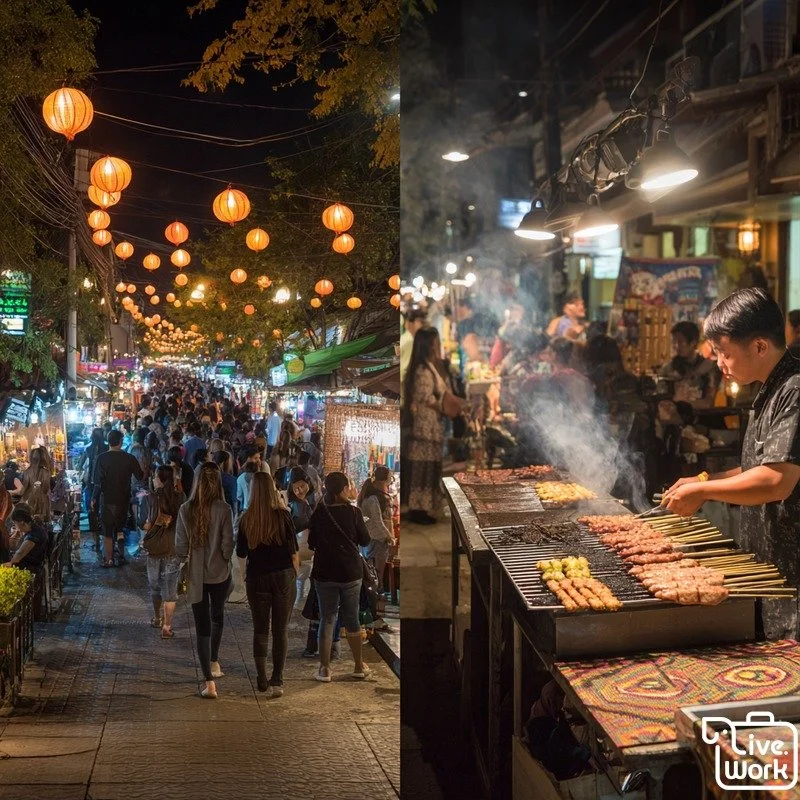
Chiang Mai Night Markets: Night Bazaar vs. Sunday Walking Street—Two Completely Different Experiences
Night markets are part of the rhythm of Chiang Mai, but not all markets here feel the same. In fact, the city offers two distinct evening experiences that often get grouped together but deserve to be understood separately. The Chiang Mai Night Bazaar and the Sunday Walking Street represent two different sides of Chiang Mai’s personality—one structured and convenient, the other local and immersive.
Choosing between them is less about which is better and more about what kind of evening you want to have.
The Night Bazaar: Structure, Convenience, and a Steady Flow
The Night Bazaar operates every evening along Chang Klan Road, and its consistency is part of its appeal. You know what you’re getting: a well-established area filled with stalls, permanent shopfronts, and clearly defined sections that make browsing feel straightforward.
Walking through the Night Bazaar, the experience feels organized. Rows of vendors display clothing, souvenirs, accessories, and decorative items, often under consistent lighting that gives the space a steady, almost predictable rhythm. It’s easy to move through, pause when something catches your eye, and continue without feeling overwhelmed.
What defines the atmosphere here is its accessibility. You don’t need to navigate long distances or dense crowds to find what you’re looking for. Everything is concentrated, making it ideal if you want to shop efficiently or prefer a more structured environment.
Food plays a supporting but still important role. Nearby food courts and restaurants provide a more settled dining experience. Instead of constantly moving, you can sit down, order a full meal, and take a break from browsing. This makes the Night Bazaar feel balanced—part shopping area, part casual dining zone.
Sunday Walking Street: Movement, Energy, and Local Character
In contrast, the Sunday Walking Street transforms Ratchadamnoen Road in the Old City into something entirely different. Once a week, the street closes to traffic and opens to a long, continuous flow of vendors, performers, and visitors.
The first thing you notice is the scale. The market stretches far beyond what you initially expect, branching into side streets and smaller lanes. Instead of a contained area, it feels like a living corridor that keeps unfolding as you walk.
The atmosphere is more dynamic and less predictable. Handmade crafts sit beside small art pieces, textiles, and locally produced goods. Many of the people selling here are also the creators, which changes the interaction. You’re not just buying an item—you’re often engaging with the person who made it.
Music and street performances add another layer. As you move, the soundscape shifts—traditional instruments in one section, modern acoustic sets in another. The experience becomes immersive, with different sensory elements blending into one continuous flow.
Food here is not centralized. It’s woven into the entire route. You move, stop, try something small, then continue. The variety feels broader, and the experience becomes a sequence of tastes rather than a single meal.
Two Markets, Two Rhythms
The difference between these two markets can be understood not just in terms of what they offer, but how they feel to move through.
| Market | Atmosphere | Highlights |
|---|---|---|
| Night Bazaar | Structured, lively, easy to navigate | Consistent shopping experience, mix of stalls and shops, centralized dining options, convenient layout |
| Sunday Walking Street | Local, festive, immersive | Handmade crafts, artisan goods, street performances, long food route with diverse snacks and regional dishes |
Food Experiences: Sitting Down vs. Snacking Through
The way you eat at each market reflects their overall character.
At the Night Bazaar, food is something you step aside for. You choose a restaurant or food court, sit down, and take a break. It’s comfortable, predictable, and allows you to pause the evening’s activity.
At the Sunday Walking Street, food is integrated into movement. You rarely stop for long. Instead, you build your meal gradually—grilled skewers, fresh juices, small desserts, and regional specialties. Each stop is brief, but together they create a varied and memorable experience.
This difference changes how the evening feels. One is anchored, the other fluid.
Timing: When to Arrive and Why It Matters
Timing plays a significant role in how you experience both markets.
For the Sunday Walking Street, arriving early—around 17:00 to 18:00—allows you to experience the market before it reaches peak density. The light is softer, the temperature more comfortable, and movement through the streets is easier. As the evening progresses, the atmosphere becomes more crowded and energetic, which can be exciting but also more intense.
The Night Bazaar benefits from the opposite approach. Arriving slightly later, around 19:00 to 21:00, brings the area to life. The lights are fully on, the stalls are active, and the environment feels vibrant without becoming overwhelming.
Understanding these timing differences allows you to shape the experience rather than react to it.
Shopping with Awareness: Respecting the Craft and the Culture
Both markets offer opportunities to buy, but how you approach shopping can influence the experience significantly.
In the Night Bazaar, bargaining is more common, especially for mass-produced items. The process is part of the interaction, and prices often reflect that expectation.
At the Sunday Walking Street, the dynamic is different. Many items are handmade, and the pricing reflects time, skill, and materials. In these cases, bargaining too aggressively can feel out of place. Paying a fair price supports the artisans and acknowledges the work behind the product.
Photography is another area where awareness matters. Asking before taking photos of products or stalls shows respect, especially when dealing with individual makers rather than larger vendors.
Choosing locally made goods over imported items also adds depth to your experience. It connects the purchase to the place, rather than turning it into a generic transaction.
The Experience Beyond Shopping
What makes these markets memorable is not just what you buy, but how they allow you to engage with the city.
The Night Bazaar offers ease. It’s a place where you can arrive without a plan, move comfortably, and find what you need without effort.
The Sunday Walking Street offers immersion. It’s a place where you lose track of time, follow the flow of people and music, and discover things you weren’t looking for.
Both experiences are valid, but they serve different moods.
Conclusion
Chiang Mai’s Night Bazaar and Sunday Walking Street are not interchangeable—they represent two distinct ways of experiencing the city after dark. The Night Bazaar provides a structured, convenient environment for relaxed shopping and dining, while the Sunday Walking Street offers a more local, immersive experience filled with handmade crafts, street performances, and a continuous flow of food and activity. By understanding the differences in atmosphere, timing, and interaction, you can choose the market that best fits your evening—or experience both to see how Chiang Mai transforms from one night to the next. In the end, the value lies not just in what you take home, but in how the experience unfolds while you’re there.